
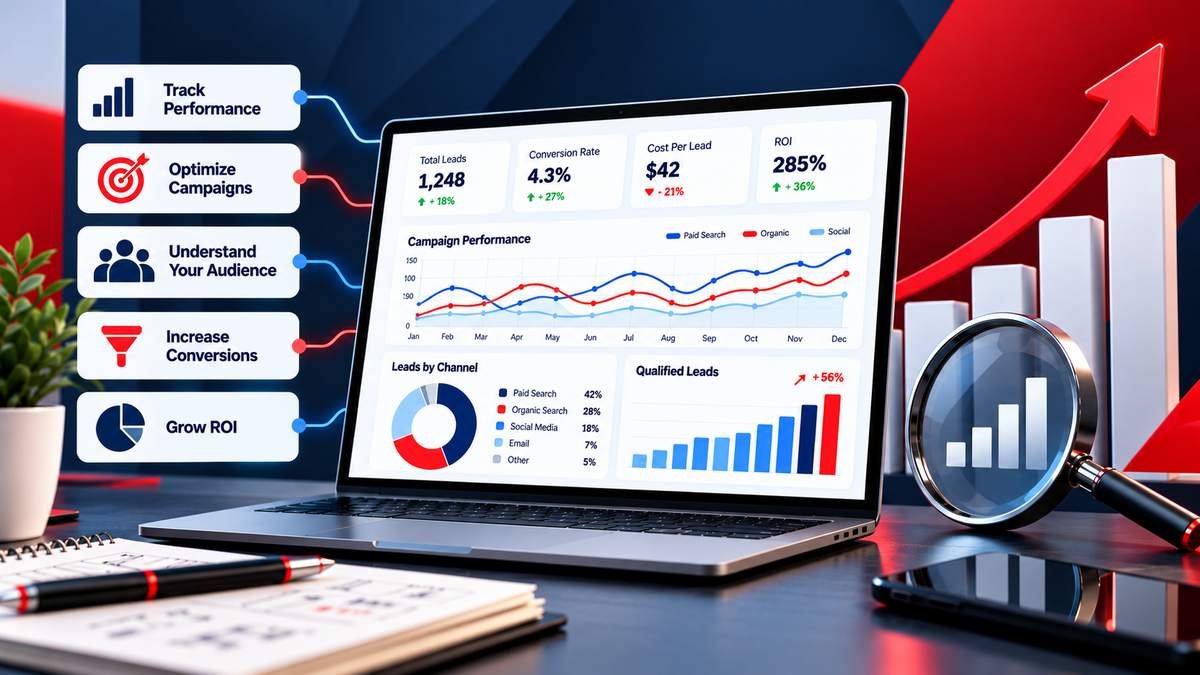
Marketing campaigns generate valuable data, but reports alone do not guarantee better results. For businesses in the U.S. lending industry, understanding which channels attract relevant prospects, generate qualified leads, and lose potential customers is essential for making informed decisions.
Marketing analytics turns campaign data into actionable insights. By analyzing advertising costs, customer interactions, conversion rates, and acquisition outcomes, marketing teams can improve campaign performance, allocate budgets more effectively, and strengthen customer acquisition.
The goal is not simply to generate more traffic or leads. It is to understand which activities contribute to business objectives and use those insights to improve future campaigns.
What Is Marketing Analytics?
Marketing analytics is the process of collecting, analyzing, and interpreting marketing data to evaluate performance and guide decisions. It helps teams understand how audiences interact with campaigns, which channels contribute to conversions, and where improvements are needed.
Unlike basic reporting, effective marketing analytics connects performance metrics with business objectives. For example, a campaign may generate substantial website traffic but few qualified leads. Analyzing the customer journey can help identify issues with targeting, landing pages, messaging, or follow-up.
For lending businesses, digital marketing analytics can reveal which channels generate relevant inquiries, how advertising spend relates to lead generation, and which campaigns deserve further investment.
Why Marketing Analytics Matters for Lending Businesses
Lending businesses operate in a competitive digital environment where acquisition costs and campaign results vary across channels. Without reliable measurement, teams may continue investing in campaigns that generate activity without delivering sufficient business value.
Improve Marketing Budget Allocation
By comparing marketing performance metrics across channels, teams can identify which activities contribute to qualified inquiries.
For example, paid search might generate many form submissions, while organic search produces fewer inquiries but a higher proportion of qualified leads. Evaluating both channels using consistent criteria helps marketers make better budget decisions.
Marketing analytics tools can combine campaign costs, website interactions, and conversion data to support these comparisons.
Understand Lead Quality
Lead volume alone does not determine campaign success. Lending businesses need to know whether inquiries match their target audience, product offering, geographic market, and business requirements.
Lead generation analytics connects acquisition activity with qualification outcomes. When marketing and sales teams share a clear definition of a qualified lead, they can improve targeting, messaging, and customer acquisition campaigns instead of optimizing only for inexpensive submissions.
Strengthen Campaign Accountability
Marketing analytics connects campaign activity with measurable indicators, including cost per lead, qualified lead rate, conversion rate, and customer acquisition cost. Reviewing these metrics together helps decision-makers understand performance changes and investigate their causes.
Key Marketing Performance Metrics to Track
The most useful marketing performance metrics depend on campaign objectives and available data. Lending businesses should prioritize measurements that connect marketing activity with meaningful acquisition outcomes.
| Metric | What It Measures | How It Helps |
| Cost per lead (CPL) | Average cost of generating a lead | Evaluates acquisition efficiency |
| Qualified lead rate | Share of leads meeting defined criteria | Assesses lead quality |
| Conversion rate | Share of visitors completing an intended action | Identifies conversion opportunities |
| Customer acquisition cost (CAC) | Cost associated with acquiring a customer | Supports budget decisions |
| Marketing ROI | Return attributable to marketing relative to its cost | Evaluates investment effectiveness |
| Landing-page conversion rate | Share of visitors completing the intended action | Reveals page improvement opportunities |
| Cost per qualified lead | Cost of generating a qualified lead | Compares lead-source efficiency |
These metrics should be interpreted together. A low cost per lead may look attractive, but a campaign can still be inefficient if most inquiries fail to meet qualification criteria. A more expensive campaign may be worthwhile if it consistently generates more relevant opportunities.
Measure Marketing ROI Accurately
Marketing return on investment (ROI) helps businesses evaluate the financial contribution of their marketing activities. It requires a clear definition of returns, reliable cost data, and an appropriate attribution approach.
Marketing ROI = (Attributed return − marketing cost) ÷ marketing cost × 100
Use a consistent definition of return and include relevant costs. For lending businesses, the appropriate financial outcome depends on the business model and available data. Marketing analytics makes ROI analysis more useful by connecting campaign costs with conversion outcomes instead of evaluating performance solely through clicks or impressions.
How to Use Marketing Analytics to Optimize Campaigns
Collecting data is only the beginning. Its value comes from using findings to make practical improvements.
1. Identify High-Performing Marketing Channels
SEO attracts organic search traffic, PPC reaches people searching for specific services, and email campaigns support ongoing engagement. Digital marketing analytics helps teams compare channels using consistent metrics.
Marketers can evaluate traffic, campaign costs, qualified lead rates, and conversion outcomes to understand each channel’s contribution. Marketing attribution adds context about the interactions preceding a conversion, helping businesses refine their channel mix and campaign optimization efforts.
2. Improve PPC Campaign Performance
Paid advertising platforms provide information about impressions, clicks, spending, and conversions. However, effective PPC campaign performance analysis should go beyond surface-level metrics.
Teams should examine search terms, audience relevance, landing-page behavior, and qualified lead outcomes. Marketing analytics can reveal keywords that attract irrelevant traffic, campaigns with high cost per qualified lead, and pages with weak conversion rates.
These insights can guide adjustments to bids, budgets, targeting, and advertising messages. Reviewing PPC campaign performance alongside organic and other channels also helps teams understand how paid advertising supports broader marketing objectives.
3. Find Conversion Bottlenecks
A campaign may attract relevant visitors but still generate few inquiries. Conversion rate optimization (CRO) helps identify friction in the customer journey.
Marketing analytics can show where visitors leave a page, which forms have low completion rates, and how behavior differs by device or traffic source. Teams can use these insights to test changes to headlines, calls to action, form fields, page structure, and page speed.
Establish a baseline, test a focused change, and evaluate the result using a relevant conversion metric. This structured approach helps teams understand which improvements contribute to better results.
4. Refine Audience Targeting and Messaging
Marketing analytics helps teams understand which audience segments engage with content, complete forms, or progress toward conversion goals.
For lending marketing, audience analysis should use appropriately collected data and comply with applicable privacy, advertising, and fair-lending requirements. Campaign insights can inform more relevant messaging and channel planning without relying on inappropriate or sensitive targeting practices.
Marketing Analytics Tools and Reporting
The right marketing analytics tools depend on a company’s technology stack, reporting needs, and resources. Businesses need reliable data and a clear process for interpreting it, rather than an unnecessarily large collection of platforms.
- Google Analytics 4 (GA4): Measures website interactions, traffic sources, and configured conversion events.
- Google Search Console: Provides organic search data, including queries, impressions, clicks, and search visibility.
- Advertising platforms: Report campaign spending, clicks, impressions, and configured conversions.
- Customer relationship management (CRM) systems: Track lead status, sales activity, and downstream outcomes.
- Dashboard tools: Combine selected data sources for consistent marketing reporting.
These marketing analytics tools work best when tracking definitions are consistent. Teams should establish clear event names, conversion criteria, campaign naming conventions, and lead qualification statuses.
Build a Useful Marketing Dashboard
A practical dashboard should answer business questions instead of displaying every available metric. A lending marketing dashboard could include:
- Spend and lead volume by channel.
- Cost per lead and cost per qualified lead.
- Landing-page conversion rates.
- Lead qualification and conversion outcomes.
- Marketing ROI, where reliable financial data is available.
- Performance trends compared with a consistent previous period.
Reporting should distinguish observed results from estimates and document limitations, particularly when conversions occur offline or across devices.
Marketing attribution can help explain the contribution of different touchpoints, but no model captures every influence on a customer’s decision. Interpret attribution alongside other evidence rather than treating it as definitive proof of causation.
Common Marketing Analytics Mistakes to Avoid
Even businesses with advanced tools can make decisions using incomplete or misleading information.
- Focusing on vanity metrics: Clicks and traffic provide context but do not independently establish success. Connect them with qualified leads and business outcomes.
- Tracking inconsistent conversions: Different conversion definitions make comparisons unreliable. Standardize tracking and document reporting criteria.
- Ignoring lead quality: Low acquisition costs are not beneficial if campaigns attract irrelevant inquiries. Include qualification data in lead generation analytics.
- Overlooking attribution limitations: A conversion may involve several channel interactions. Interpret attribution carefully and acknowledge tracking gaps.
- Making changes without testing: Short-term fluctuations can mislead. Use appropriate comparison periods and structured testing.
- Reporting without action: Use findings to refine targeting, improve landing pages, adjust budgets, or investigate tracking problems.
Avoiding these mistakes makes marketing analytics a decision-making framework rather than simply a reporting exercise.
How to Build a Data-Driven Marketing Strategy
A data-driven marketing strategy starts with business objectives and identifies the information needed to measure progress. Lending businesses can follow this process:
- Define the objective. Decide whether the priority is increasing qualified leads, reducing acquisition costs, or improving conversion rates.
- Select relevant metrics. Choose marketing performance metrics directly related to the objective.
- Verify tracking. Confirm that website events, advertising conversions, and lead statuses are recorded consistently.
- Establish a baseline. Record current performance before making major changes.
- Analyze results. Use marketing analytics to identify patterns, bottlenecks, and opportunities.
- Test improvements. Make focused changes and evaluate their effects.
- Review and refine. Apply findings to ongoing campaign optimization and budget planning.
This process makes digital marketing analytics part of everyday decision-making and connects campaign activity with lead quality and customer acquisition outcomes.
Turn Marketing Data Into Better Campaign Decisions With NWT Marketing
Effective marketing analytics requires reliable tracking, meaningful performance metrics, and a clear process for turning insights into improvements.
NWT Marketing helps businesses in the U.S. lending ecosystem strengthen their digital marketing through SEO, PPC, lead generation, marketing analytics, marketing automation, and conversion rate optimization.
Whether your team needs clearer reporting, better campaign visibility, or a more structured approach to customer acquisition, NWT Marketing can help develop a strategy aligned with your business objectives.
Ready to make more informed marketing decisions? Talk to NWT Marketing about building a data-driven growth strategy.
FAQs
How does marketing analytics improve campaign performance?
Marketing analytics identifies which channels, campaigns, and landing pages contribute to business objectives. By analyzing costs, conversions, and lead quality, businesses can refine targeting, improve the customer journey, and allocate budgets more effectively.
What marketing performance metrics should lending businesses track?
Relevant metrics include cost per lead, cost per qualified lead, lead qualification rate, conversion rate, customer acquisition cost, and marketing ROI. The right metrics depend on business goals and available data.
Which marketing analytics tools are useful for lending businesses?
GA4, Google Search Console, advertising platform reports, CRM systems, and dashboard tools support different parts of measurement. The best combination depends on the channels used and how reliably systems share data.
How can marketing analytics reduce customer acquisition costs?
Marketing analytics can reveal campaigns that generate irrelevant leads, landing pages that lose interested visitors, and channels that use budgets inefficiently. Acting on these insights may improve acquisition efficiency, depending on implementation and market conditions.
What is the difference between marketing analytics and marketing reporting?
Marketing reporting presents performance information in a structured format, while marketing analytics investigates what the data means and how it can inform decisions. Reporting shows what happened; analytics helps teams explore why it happened and what to test next.