
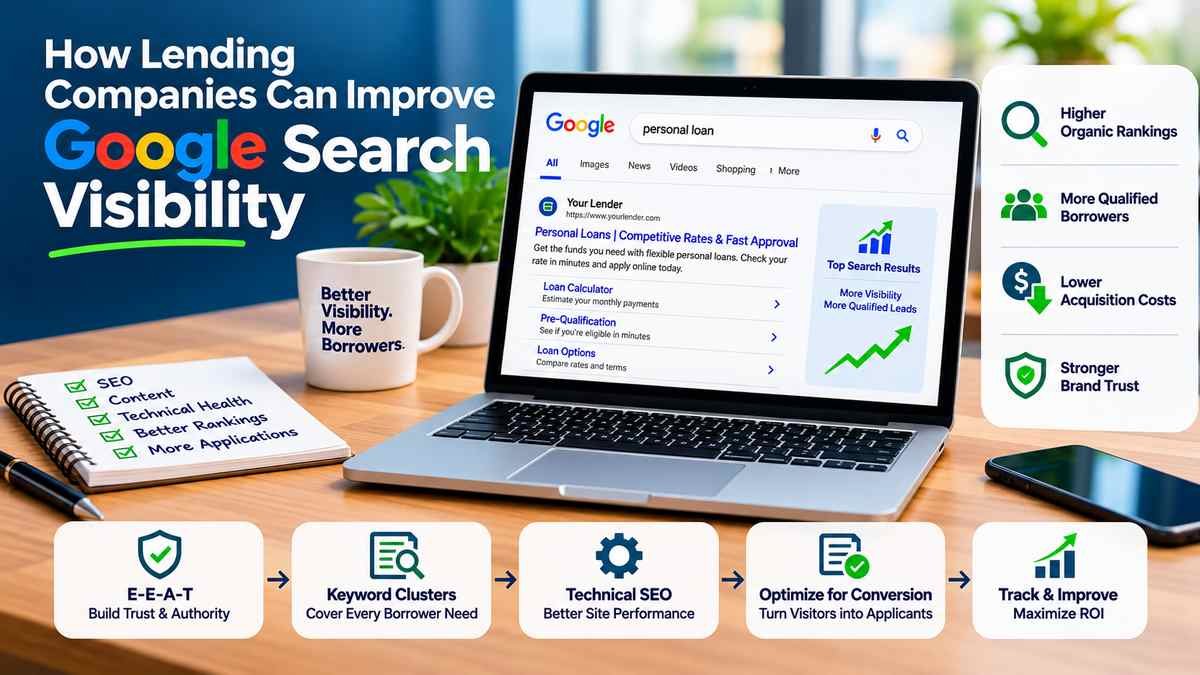
Consumer lending operates in one of the most competitive customer acquisition environments in the United States. For lending company owners, marketing directors, digital growth leaders, and customer acquisition teams, relying exclusively on paid search ads or purchasing non-exclusive leads from third-party aggregators presents significant long-term commercial challenges. Scaling pay-per-click spend often leads to escalating cost per acquisition metrics, volatile lead quality, and intense bidding competition against national financial institutions.
While paid advertising provides immediate volume, it captures intent only at the final moment of decision and at a premium cost. Maximizing your Google search visibility offers consumer lenders a scalable, long-term framework to capture prospective borrowers early in their research process. By building technical domain health, publishing E-E-A-T-compliant financial content, and targeting high-intent search terms, lending institutions can establish a sustainable inbound lead generation engine that drives consistent loan volume.
Step 1: Establish Strict E-E-A-T and YMYL Compliance Across Digital Properties
Google categorizes financial and lending websites as “Your Money or Your Life” (YMYL) properties because the information provided can directly impact a consumer’s financial well-being. Consequently, improving Google search visibility requires establishing exceptional levels of Experience, Expertise, Authoritativeness, and Trustworthiness (E-E-A-T).
Lending websites that lack visible compliance signals, accredited author bios, or clear regulatory disclosures face severe ranking penalties across organic search engine results pages (SERPs).
- Detailed Author Attribution: Ensure all educational articles are authored or reviewed by verified financial experts, certified financial planners, or veteran lending officers. Include detailed author bio pages with professional credentials and LinkedIn profiles.
- Transparent Licensing and Disclosures: Display state lending licenses, NMLS numbers, physical office addresses, and clear disclosures regarding interest rate ranges, APR calculations, and repayment terms near all financial content.
- Authentic Customer Reviews and Social Proof: Integrate verified customer review feeds, Trustpilot widgets, and BBB accreditation badges directly into key landing pages to establish immediate brand authority.
Partnering with specialized experts in b2b marketing financial services guarantees that your digital properties satisfy Google’s strict quality rater guidelines, laying the groundwork for higher organic rankings.
Step 2: Build Topical Authority Through Keyword Clustering and Hub-and-Spoke Content
To achieve dominant Google search visibility, lending platforms must move beyond isolated blog posts and construct interconnected content ecosystems around core lending products.
Google rewards websites that demonstrate comprehensive topical coverage. Building structured hub-and-spoke content models establishes domain authority across competitive search terms.
Structuring your content model around high-intent borrower search queries maximizes organic reach:
Central Hub Pages
Create comprehensive pillar pages for primary credit offerings (e.g., Personal Loans, Debt Consolidation Loans, or Business Lines of Credit). These pages explain core features, rate structures, and eligibility parameters.
Cluster Articles
Surround pillar pages with targeted supporting articles answering specific borrower questions:
- How Debt Consolidation Impacts Credit Scores
- Personal Loan vs. Balance Transfer: Which Saves More Money?
- What Credit Score Is Needed for Online Loan Approval?
Internal Link Architecture
Connect cluster articles back to primary product hubs using clear, descriptive anchor text. This internal linking structure passes PageRank effectively across your site and signals complete topical depth to Google crawlers.
Expanding your topical footprint drives sustainable loan lead generation by capturing prospective borrowers across every stage of their financial decision-making process.
Step 3: Optimize Technical SEO and Site Architecture for Financial Platforms
A content strategy is only as effective as the technical foundation supporting it. Poor site speed, mobile rendering issues, or broken crawl paths will undermine Google search visibility, regardless of content quality.
Executing a technical SEO audit ensures search crawlers can index and interpret your lending portal efficiently:
- Core Web Vitals Optimization: Optimize page load speeds, interactive responsiveness, and visual stability. Financial consumers quickly abandon slow-loading forms, which degrades both user experience and organic rankings.
- Mobile-First Form Design: Over 60% of consumer loan inquiries originate on mobile devices. Ensure all lead capture tools, interest calculators, and pre-qualification forms are fully responsive with large touch targets.
- Structured Data Schema Implementation: Implement Schema.org markup (including FinancialProduct, FAQPage, Organization, and Article schemas). Structured data helps search engines extract key loan details and display rich snippets directly in Google SERPs.
Maintaining robust technical health accelerates indexing and boosts organic rankings, creating a solid foundation for specialized b2b financial services growth strategies.
Step 4: Integrate Pre-Screening Tools to Enhance Lead Quality
Improving Google search visibility increases site traffic, but generating raw traffic is only valuable if visitors convert into qualified leads. Without proper pre-qualification mechanisms, high search visibility can lead to an influx of non-viable inquiries that overwhelm underwriting teams.
To protect lead quality for lending businesses, lenders should integrate interactive pre-screening widgets directly into high-ranking content pages.
- Interactive Interest Estimators: Provide payment calculators that allow users to select loan amounts, repayment terms, and estimated credit tiers. Requiring engagement before form submission ensures applicants understand loan obligations.
- Multi-Step Qualification Forms: Implement multi-step forms that ask essential pre-screening questions (e.g., employment status, monthly income, primary loan purpose) prior to requesting contact details.
- Soft Credit Inquiry Integration: Integrate soft credit pulls into initial qualification tools. This verifies applicant eligibility instantly without impacting credit scores or adding manual underwriting labor.
Adding strategic qualification steps improves downstream conversion rate optimization by turning organic search traffic into pre-qualified, high-intent inquiries.
Step 5: Optimize Content for AI Search and Direct-Answer SERP Features
Modern borrowers increasingly discover lending options through AI-driven search environments (such as Google AI Overviews, Perplexity, and ChatGPT) as well as traditional search listings. Maximizing Google search visibility requires optimizing content for generative search engines and featured snippets.
Applying Generative Engine Optimization (GEO) tactics ensures your content is selected as a primary answer source:
- Direct-Answer Formatting: Place concise, 40-to-50-word definitions or direct answers immediately below H2 headers framing common financial questions (e.g., “What is a debt consolidation loan?”).
- Structured Tables and Comparison Matrixes: Use clear HTML tables to display rate comparisons, term lengths, and fee structures. Search engines favor structured data when generating featured snippets and AI answers.
- Clear Bulleted Action Steps: Format complex financial processes (e.g., application steps or documentation checklists) as clear, numbered or bulleted lists.
Optimizing for modern search features expands your brand presence across organic SERPs, driving high-intent borrowers directly to your application funnel while steadily lowering your overall cost per acquisition.
Step 6: Measure Organic Performance with Closed-Loop Attribution
To justify ongoing investment in organic search, financial executives must connect Google search visibility directly to loan origination metrics. Tracking surface-level metrics like impressions or raw page views is insufficient for evaluating commercial success.
Establishing a closed-loop analytics bridge between Google Analytics 4, Google Search Console, and your Loan Origination System (LOS) provides complete performance clarity.
| Performance Focus | Top-of-Funnel Search Metrics | Mid-Funnel Conversion Metrics | Closed-Loop Commercial Metrics |
| Primary Metric | Organic impressions & keyword rank | Pre-qualification form submissions | Final funded loan origination volume |
| Data Source | Google Search Console / GA4 | CRM & Landing Page Analytics | Loan Origination System (LOS) |
| Optimization Focus | Expanding search visibility | Enhancing conversion rate optimization | Lowering total cost per acquisition |
| Strategic Value | Measures brand search reach | Evaluates applicant pre-qualification | Proves true marketing return on investment |
Tracking closed-loop attribution allows growth teams to identify which search queries, educational hubs, and content assets yield the highest-converting loan applicants. This data enables lenders to double down on high-performing topics and maximize long-term marketing ROI.
Scale Your Search Dominance with NWT Marketing
Building exceptional Google search visibility that turns organic search traffic into qualified loan originations requires specialized financial marketing expertise. At NWT Marketing, we partner exclusively with U.S. consumer lending companies, digital credit platforms, and financial institutions to engineer high-performing organic growth programs.
Whether your objective is to lower your cost per acquisition, improve lead quality for lending businesses, or refine your conversion rate optimization strategy, our team delivers data-driven B2B solutions tailored specifically to the lending industry.
Ready to dominate organic search and attract high-intent borrowers?
Talk to NWT Marketing Today to Build Your Custom Strategy
FAQs
How long does it take for a lending company to improve its Google search visibility?
Noticeable improvements in Google search visibility typically occur within 3 to 6 months after fixing technical SEO issues, establishing E-E-A-T signals, and publishing structured topic clusters. Because financial content falls under YMYL guidelines, building domain authority requires consistent, high-quality optimization over time.
Why is E-E-A-T so important for financial and lending websites?
Google applies higher quality standards to financial websites because misleading or inaccurate information can cause financial harm to consumers. Demonstrating E-E-A-T through verified author credentials, clear regulatory disclosures, and transparent loan terms is essential for earning top organic search rankings.
How does higher Google search visibility reduce customer acquisition costs for lenders?
Improving organic search visibility creates permanent digital assets that attract prospective borrowers naturally without ongoing pay-per-click costs. As organic traffic grows, your blended cost per acquisition drops, reducing reliance on expensive paid ads or purchased lead lists.
What role does conversion rate optimization play in search visibility campaigns?
Search visibility drives visitors to your site, but conversion rate optimization ensures those visitors turn into active applicants. By optimizing form fields, page layouts, and trust indicators, CRO maximizes the volume of qualified leads generated from your organic search traffic.