
Lending companies operate in a competitive digital environment where attracting qualified borrowers requires a well-planned customer acquisition strategy. As advertising costs increase and prospective borrowers become more selective, relying exclusively on paid campaigns can make sustainable growth more difficult. Businesses need marketing channels that generate visibility, attract relevant audiences, and support conversions without depending on a single traffic source.
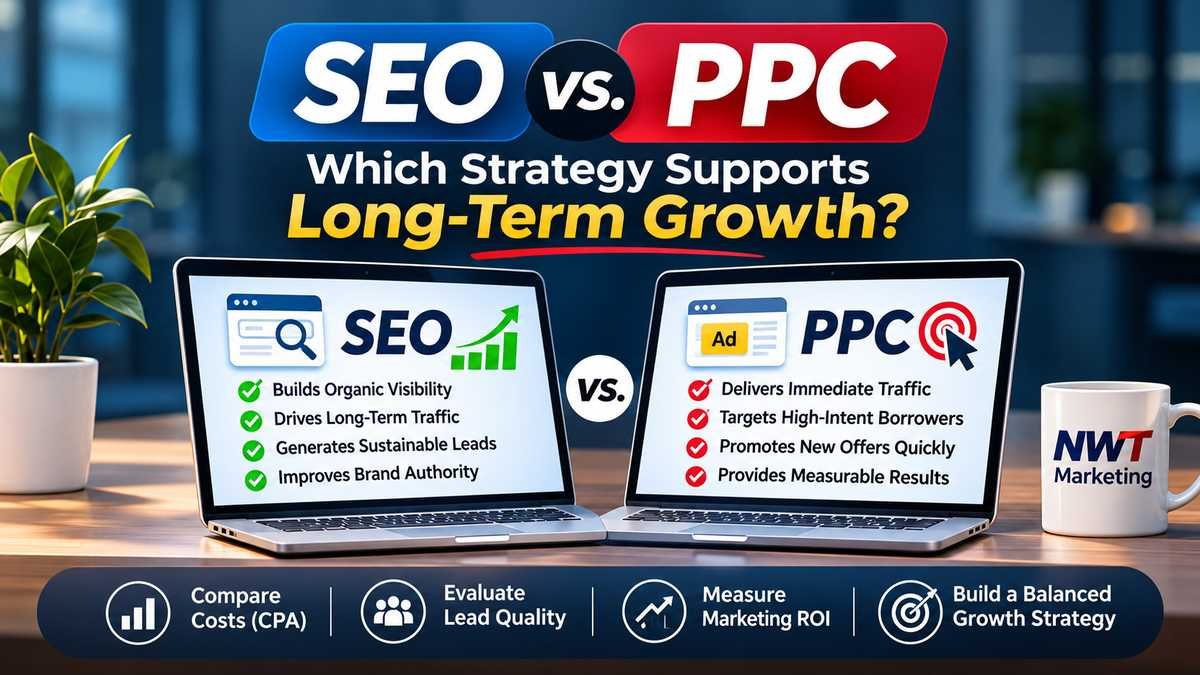
The discussion around SEO vs PPC is particularly important for lending businesses because both channels address different stages of the customer acquisition journey. Search engine optimization (SEO) helps companies build organic visibility and attract visitors through unpaid search results. Pay-per-click (PPC) advertising provides immediate exposure through sponsored search listings and other paid placements.
Although both approaches can generate leads, they differ in cost structure, speed, sustainability, and performance measurement. Understanding these differences helps marketing decision-makers allocate budgets more effectively, improve lead quality, and develop a digital marketing strategy that supports long-term business objectives.
Understanding SEO and PPC in Lending Marketing
Before deciding which channel deserves more investment, lending companies should understand how each approach works and how it contributes to their overall lending marketing strategy.
What Is Search Engine Optimization (SEO)?
SEO is the process of improving a website’s visibility in organic search engine results. It involves optimizing technical performance, website content, keyword targeting, internal linking, and authority signals to help search engines understand and rank relevant pages.
For lending businesses, SEO creates opportunities to reach prospective borrowers while they research lending products, eligibility requirements, application processes, and financial questions.
An effective financial services SEO strategy typically includes:
- Keyword research: Identifying relevant search terms based on borrower intent and business objectives.
- Technical SEO: Improving website speed, mobile usability, crawlability, and indexability.
- Content optimization: Publishing accurate, helpful resources that answer prospective borrowers’ questions.
- Internal linking: Connecting related service pages, educational articles, and conversion-focused resources.
- Authority development: Strengthening credibility through expert-reviewed content, transparent business information, and relevant external references.
Unlike paid advertising, organic visibility is earned through ongoing website improvements rather than purchasing individual clicks.
What Is Pay-Per-Click Advertising (PPC)?
PPC is a paid advertising model in which businesses generally pay when users click on their advertisements. Search campaigns can place lending businesses in sponsored results when people search for relevant products or services.
A PPC advertising strategy may include:
- Selecting relevant commercial keywords.
- Creating targeted search advertisements.
- Setting campaign budgets and bidding strategies.
- Developing dedicated landing pages.
- Targeting specific geographic locations and eligible audiences.
- Monitoring conversions, advertising costs, and campaign performance.
For lending companies, paid search advertising can provide immediate access to users actively researching lending options. However, maintaining this visibility generally requires continued advertising investment.
SEO vs PPC: Understanding the Key Differences
Both channels can attract prospective borrowers, but they operate differently and require different management approaches.
| Comparison Factor | SEO | PPC |
| Traffic source | Organic search results | Paid advertisements |
| Time to visibility | Builds gradually | Can begin quickly |
| Cost structure | Content, technical optimization, and ongoing management | Advertising spend and campaign management |
| Traffic sustainability | Can continue generating visits after rankings improve | Depends on continued campaign activity |
| Targeting | Search intent, keywords, and content relevance | Keywords, audiences, locations, and campaign settings |
| Main objective | Build organic visibility and authority | Capture targeted demand and generate immediate traffic |
| Performance measurement | Organic traffic, rankings, leads, and conversions | Clicks, impressions, conversions, and advertising costs |
| Long-term contribution | Builds an organic acquisition asset | Supports ongoing paid acquisition |
The central difference is that SEO focuses on earning visibility through useful content and website quality, while PPC purchases advertising exposure through campaign budgets.
When evaluating SEO vs PPC, lending companies should avoid judging performance using traffic volume alone. A campaign that generates thousands of clicks may deliver limited business value if visitors do not meet qualification requirements or complete applications.
Similarly, an SEO campaign should not be considered successful simply because keyword rankings improve. Its performance should also be measured through relevant inquiries, application activity, and qualified lead generation.
Why SEO Can Support Long-Term Growth for Lending Companies
Organic search can become a valuable acquisition channel when businesses consistently invest in technical improvements, relevant content, and website authority.
1. Generate Sustainable Organic Search Traffic
Prospective borrowers use search engines to understand lending products, compare requirements, and find answers before making application decisions.
Lending companies can attract these users by developing educational content around relevant search topics. For example, articles explaining application requirements, repayment structures, eligibility considerations, and lending terminology can reach audiences during the early stages of their research.
This creates opportunities to generate organic search traffic from users who may not yet be ready to submit an inquiry but are actively looking for information.
A structured content strategy should connect informational articles with relevant service pages. This allows visitors to move naturally from researching a topic to learning about available products and application processes.
2. Build Authority and Strengthen Brand Trust
Financial websites require particular attention to content accuracy and transparency because misleading information can affect important consumer decisions.
Lending companies should demonstrate credibility through expert-reviewed educational resources, clear author information, appropriate disclosures, and accurate product descriptions.
A consistent financial services SEO strategy can also strengthen topical authority by covering related subjects in depth rather than publishing disconnected articles targeting unrelated keywords.
Over time, this approach helps establish a more informative digital presence and gives prospective borrowers additional reasons to trust the business.
3. Create Opportunities for Organic Lead Generation
SEO should connect website visibility with meaningful conversion opportunities.
For example, a visitor reading an article about lending eligibility may benefit from a contextual link to a relevant product page or an application requirements guide.
Businesses can improve this journey through:
- Relevant calls to action within educational content.
- Clear product and service information.
- Mobile-friendly application experiences.
- Helpful eligibility resources.
- Simple and transparent inquiry forms.
These improvements help turn organic visitors into potential applicants while supporting organic lead generation across different stages of the borrower journey.
4. Diversify Customer Acquisition Channels
Relying entirely on paid advertising can expose businesses to changes in advertising costs, competition, and campaign performance.
SEO provides another acquisition channel that can attract visitors without requiring a payment for every click. Although organic growth still requires ongoing investment, successful content can continue generating search visibility after publication.
This can help lending businesses diversify their acquisition mix and reduce dependence on paid traffic over time.
When PPC Is the Better Choice for Lending Businesses
SEO offers long-term opportunities, but paid campaigns remain valuable when businesses need faster exposure or greater control over specific marketing activities.
1. Launching New Products and Campaigns
When a lending company introduces a new product or targets a new geographic market, its website may not immediately rank for relevant searches.
PPC can help generate exposure while the business develops supporting organic content and improves its search presence.
2. Reaching High-Intent Audiences
Some search queries indicate that users are actively evaluating available lending options.
Paid search advertising allows businesses to target relevant commercial searches and direct visitors to dedicated landing pages. However, keyword selection should consider search intent, advertising competition, geographic eligibility, and the likelihood of attracting suitable applicants.
3. Testing Advertising Messages and Landing Pages
Paid campaigns can provide useful data about keyword performance, advertisement messaging, and landing page engagement.
Marketing teams can use these insights to identify which messages attract relevant prospects and which landing page elements encourage conversions.
The findings can also inform SEO content planning and broader digital marketing decisions.
4. Supporting Short-Term Marketing Objectives
PPC is useful when businesses need to promote time-sensitive campaigns or generate immediate visibility.
Campaigns can be adjusted according to available budgets, geographic targeting, and performance objectives. However, advertising spend should be monitored closely to ensure that increased traffic contributes to meaningful business outcomes.
SEO vs PPC: Which Strategy Offers Better Marketing ROI?
Choosing an acquisition channel requires evaluating the relationship between marketing investment and commercial results. The comparison of SEO vs PPC becomes more useful when businesses consider cost per acquisition (CPA), lead quality, and the value generated beyond initial website visits.
Compare Cost Per Acquisition (CPA)
Cost per acquisition measures the amount spent to generate a defined conversion.
For PPC, businesses can compare advertising costs with the number of conversions generated by their campaigns.
For SEO, the calculation should account for content production, technical optimization, agency fees, and other ongoing investments. These costs should then be compared with the qualified conversions attributed to organic search.
The objective is not simply to identify the channel with the lowest cost per lead. It is to understand which channel generates commercially valuable outcomes.
Evaluate Customer Acquisition Costs
Customer acquisition costs should include the broader expenses associated with converting prospects into customers.
Lending companies should consider whether leads meet initial eligibility requirements, complete applications, and progress through the business’s acquisition process.
A channel that generates inexpensive inquiries may still be inefficient if a significant percentage of those leads are unsuitable.
Measure Marketing ROI Beyond Traffic
Marketing ROI should connect channel performance with meaningful business outcomes.
A useful measurement framework includes:
- Organic impressions and clicks.
- Paid advertising costs and conversions.
- Qualified inquiries and application submissions.
- Application completion rates.
- Cost per qualified lead.
- Customer acquisition costs.
- Downstream conversion and origination outcomes, where available.
Connecting Google Analytics 4, Google Search Console, advertising platforms, CRM data, and relevant application systems can provide a clearer view of performance.
This approach helps decision-makers evaluate marketing ROI based on business results rather than impressions and clicks alone.
How to Combine SEO and PPC for Sustainable Growth
For many lending businesses, combining both channels offers a more balanced acquisition strategy. Rather than treating them as competing investments, marketing teams can use each channel to support different objectives.
1. Use PPC Insights to Inform SEO Planning
Paid campaigns can reveal which search terms attract relevant visitors and generate meaningful conversions.
Marketing teams can review this data to identify topics worth developing into organic landing pages, educational articles, and supporting resources.
2. Build Content Around Search Intent
Once valuable search themes are identified, businesses can create content that addresses the questions and needs behind those searches.
A well-organized SEO strategy should include product pages, supporting articles, and internal links that guide visitors toward relevant information.
3. Improve Landing Page Performance Across Both Channels
Landing page quality affects the performance of both organic and paid traffic.
Clear messaging, relevant calls to action, transparent information, and simple forms can improve the visitor experience and support conversion rate optimization.
4. Allocate Budgets Based on Performance
Businesses should regularly review channel performance and adjust investment according to lead quality, conversion rates, and acquisition objectives.
For example, PPC may receive greater attention during a product launch, while SEO investment continues building organic visibility and content authority.
This balanced approach helps businesses manage short-term acquisition needs without neglecting long-term growth.
Build a Sustainable Lending Marketing Strategy with NWT Marketing
The decision between SEO and PPC should reflect a lending company’s business objectives, competitive environment, available resources, and customer acquisition targets.
At NWT Marketing, we help U.S. lending businesses develop data-driven digital marketing strategies focused on search visibility, qualified lead generation, and measurable performance.
Our services include financial services SEO, PPC campaign management, content marketing, lead generation, marketing analytics, and conversion rate optimization.
Whether your business needs to strengthen its organic presence, improve paid campaign efficiency, or manage customer acquisition costs, our team develops marketing solutions aligned with your long-term objectives.
Ready to build a stronger digital presence and support sustainable growth?
Talk to NWT Marketing Today to Build Your Custom Strategy.
FAQs
Is SEO better than PPC for long-term growth?
SEO can support long-term growth by building organic visibility, topical authority, and sustainable traffic opportunities. PPC is more suitable for immediate paid exposure. The right approach depends on competition, available budgets, and business objectives.
How long does SEO take to generate results for lending businesses?
SEO timelines depend on website authority, competition, technical performance, content quality, and optimization efforts. Some improvements may become visible within a few months, while competitive financial search terms can take considerably longer.
Is PPC more expensive than SEO?
The two channels have different cost structures. PPC requires advertising spend to maintain paid visibility, while SEO requires ongoing investment in content, technical improvements, and optimization. Actual costs depend on competition and campaign execution.
Can lending companies use SEO and PPC together?
Yes. Lending businesses can use PPC to generate immediate visibility and gather campaign insights while SEO builds organic search presence. Combining both channels can diversify acquisition sources and support more balanced marketing performance.
Which channel generates better-quality leads for lenders?
Neither channel automatically produces better-quality leads. Lead quality depends on search intent, targeting, landing page relevance, eligibility messaging, and qualification processes. Businesses should compare qualified lead rates and downstream conversion performance.