
Lead generation for lending businesses requires more than generating a high volume of inquiries. Lenders need to attract relevant prospects, qualify opportunities, and connect marketing activity with measurable business outcomes.
The goal is to attract the right prospects, capture meaningful information, qualify opportunities, and move potential customers through the acquisition funnel.
A strong strategy can combine SEO, paid search, content marketing, landing pages, social media, lead nurturing, marketing automation, and analytics. The right mix depends on the company’s audience, products, market, and conversion process.
This guide explains how lead generation works for lending businesses and how marketing teams can build a more effective system for attracting and converting qualified prospects.
What Is Lead Generation for Lending Businesses?
Lead generation is the process of attracting potential customers and converting their interest into identifiable prospects that a business can qualify and nurture.
A lending lead might be generated when someone:
- Completes a lead form
- Requests information
- Starts an application
- Calls the business
- Requests a consultation
- Submits business financing information
- Engages with a targeted landing page
Not every lead has the same value. A qualified lead meets criteria established by the business, such as audience fit, product interest, geographic eligibility, or other relevant requirements.
The first step is therefore to define what a valuable lead means before launching campaigns.
How the Lending Lead Generation Funnel Works
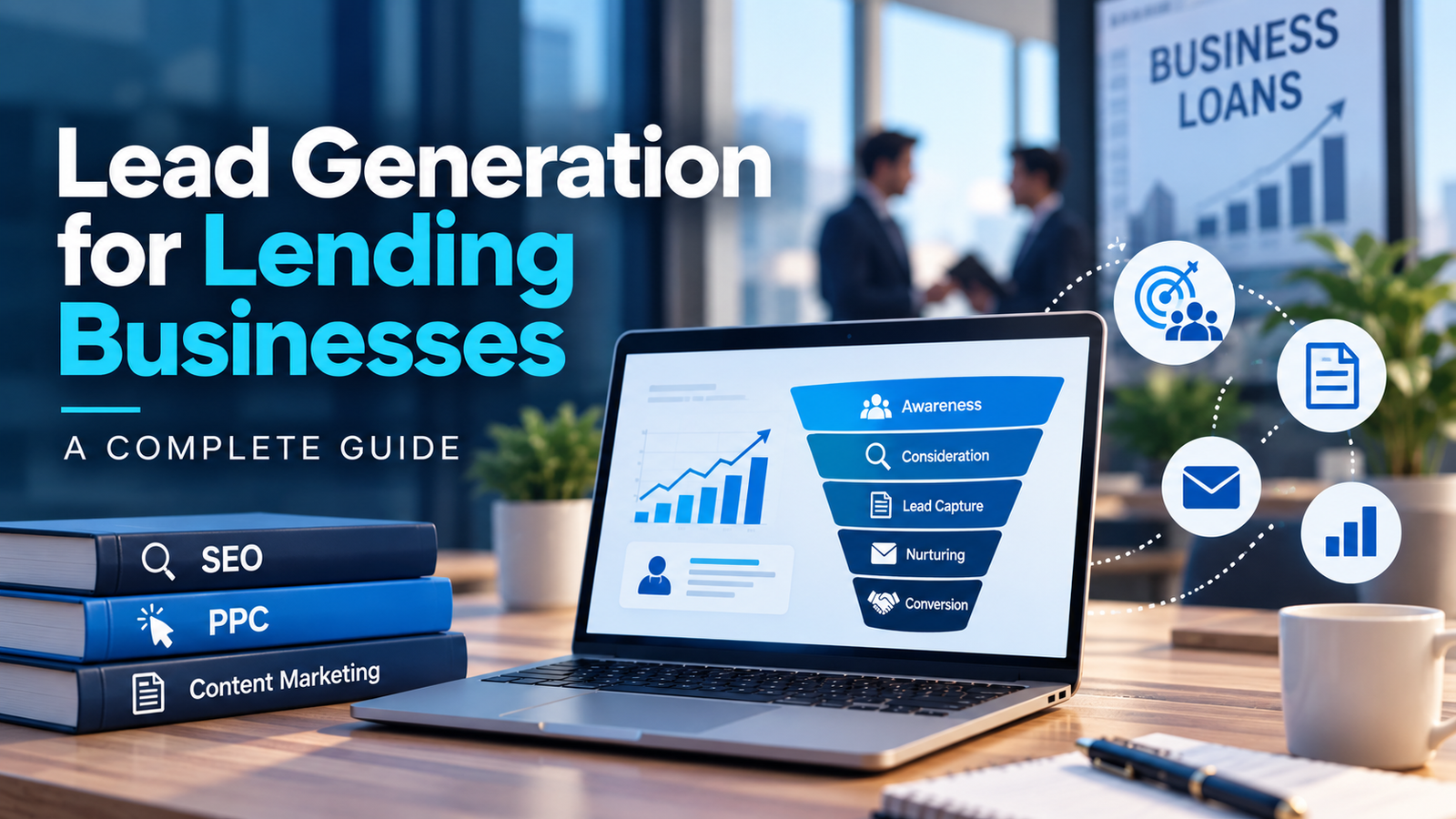
A typical acquisition funnel includes six stages:
1. Awareness
Prospects discover a lender through organic search, paid advertising, social media, content, referrals, or partnerships.
2. Consideration
They research their options, compare providers, and look for information related to their needs.
3. Lead Capture
The prospect completes a form, requests information, makes a call, or takes another measurable action.
4. Qualification
The business evaluates whether the prospect matches its target audience and qualification criteria.
5. Lead Nurturing
Prospects who are not ready to take the next step can receive relevant content, email communication, follow-up, or other appropriate touchpoints.
6. Conversion
Depending on the business model, marketing may contribute to applications, qualified opportunities, funded accounts, or other downstream outcomes.
This is why lenders should evaluate marketing beyond the initial lead submission.
8 Lead Generation Strategies for Lending Businesses
1. Build SEO Around Lending Intent
SEO can help lenders reach prospects searching for relevant information, services, and solutions.
Instead of targeting broad financial topics, create content around genuine search intent, such as:
- Commercial lending
- Business financing
- Financing requirements
- Industry-specific financing
- Lending terminology
- Business loan information
A strong SEO strategy can combine service pages, educational content, FAQs, supporting articles, and other relevant pages.
The goal is to attract high intent leads, not simply increase organic traffic.
2. Use Paid Search
Google Ads and other paid search campaigns can help businesses reach people actively searching for relevant services.
However, financial advertising requires careful attention to platform policies and applicable regulations. Google’s financial products and services policy includes requirements and restrictions that can apply to advertisers and lead generators.
Campaigns should therefore be reviewed for appropriate messaging, disclosures, targeting, and compliance before launch.
3. Create Dedicated Landing Pages
Sending every campaign visitor to the homepage can create unnecessary friction.
Dedicated landing pages allow the message, content, and CTA to match the visitor’s intent.
A strong landing page should clearly explain:
- Who the company serves
- What service is relevant
- What the visitor can expect
- What action they can take
- What information is required
- Any relevant disclosures
4. Use Content Marketing
Content can support both SEO and lead nurturing.
Useful topics could include:
- How commercial lending works
- Business financing considerations
- Commercial lending terminology
- Financing processes
- Questions businesses ask before contacting a lender
Content should answer real customer questions rather than exist simply to increase publishing volume.
5. Develop a Lead Nurturing Strategy
Not every prospect converts immediately.
A lead nurturing strategy can keep the company relevant through appropriate email, educational content, follow-up workflows, and other touchpoints.
For example, someone who downloaded an educational resource may need different communication from someone who has already requested a conversation.
The objective is to make follow-up relevant rather than simply increasing message frequency.
6. Use Marketing Automation
Marketing automation can help teams manage repetitive processes such as:
- Lead routing
- Lead scoring
- Email workflows
- Audience segmentation
- CRM synchronization
- Follow-up reminders
- Campaign reporting
For example, a new lead can enter the CRM, be assigned to the appropriate team, and enter a relevant follow-up workflow.
Automation should support the customer journey rather than replace human judgment.
7. Focus on Lead Quality
Generating more lending leads does not necessarily mean generating better business opportunities.
Marketing and sales teams should agree on qualification criteria such as:
- Audience fit
- Product fit
- Geographic eligibility
- Financing intent
- Business characteristics
- Engagement
- Application stage
This allows marketing teams to optimize for qualified opportunities rather than raw lead volume.
8. Connect Marketing With Business Outcomes
A useful measurement path looks like:
Keyword → Ad/Content → Landing Page → Lead → Qualified Lead → Application → Outcome
Without this connection, a campaign can appear successful simply because it produces inexpensive leads.
Track metrics such as:
- Leads
- Qualified leads
- Cost per lead
- Cost per qualified lead
- Applications
- Conversion rates
- Customer acquisition cost
- Downstream business outcomes
Business Loan Lead Generation Requires a Targeted Approach
Business loan lead generation often involves a longer research process.
Business owners may research financing options, requirements, costs, eligibility, and different providers before taking action.
That creates multiple opportunities for marketing teams to provide useful information throughout the journey.
A strong strategy can combine SEO, paid search, content, landing pages, lead nurturing, sales enablement, and analytics.
The messaging should remain factual and should never promise approval, guaranteed funding, or specific financial outcomes.
What About Financial Advisor Leads?
Financial advisor leads represent a related but different acquisition category.
Financial advisor lead generation may focus on financial planning, retirement planning, investment management, or other professional services rather than lending.
The same marketing channels can be useful, including SEO, PPC, content, landing pages, nurturing, and automation.
The broader principle also applies to financial lead generation: marketing strategy should reflect the specific financial service being promoted rather than treating every financial-services audience as identical.
Commercial Lending Marketing
Effective commercial lending marketing should connect a company’s expertise with the needs of its target business audience.
A practical strategy can include:
- Technical SEO
- Commercial-intent keyword research
- Educational content
- Paid search
- Landing page optimization
- Email marketing
- Lead nurturing
- CRM integration
- Marketing automation
- Conversion tracking
For example, a commercial lender may create dedicated content and landing pages for relevant industries or business segments where there is a clear audience need.
Common Lead Generation Mistakes
Focusing Only on Lead Volume
More leads do not automatically mean better marketing. Low-quality leads can increase sales workload without improving business outcomes.
Using One Landing Page for Everything
Different campaigns have different audiences and intent. Relevant landing pages can create a clearer path to conversion.
Ignoring Lead Nurturing
Some prospects need more time and information before taking the next step. Without an appropriate nurturing process, potential opportunities can be lost.
Failing to Track the Full Funnel
Tracking only form submissions hides what happens after the lead is created. Connect marketing data with CRM and downstream outcomes where possible.
Making Unsupported Financial Claims
Financial marketing requires careful messaging. Teams should review advertising claims, disclosures, lead-routing practices, and applicable requirements before launching campaigns. The CFPB has also addressed practices involving digital intermediaries and lead generation for consumer financial products.
How to Build a Lead Generation Strategy
A practical process is:
- Define the target audience and ideal customer profile.
- Research search intent and identify relevant demand.
- Select acquisition channels such as SEO, PPC, content, and social media.
- Build conversion assets including landing pages and forms.
- Define lead qualification criteria with sales.
- Connect CRM and marketing data for attribution.
- Implement lead nurturing for prospects who need additional engagement.
- Measure and optimize based on qualified opportunities and downstream outcomes.
Conclusion
Effective lead generation is about more than increasing form submissions.
For lending businesses, a strong acquisition strategy connects SEO, paid search, content, landing pages, lead qualification, nurturing, automation, and measurement.
The goal is to build a system that moves prospects through:
Attract → Capture → Qualify → Nurture → Convert → Measure → Optimize
When marketing teams connect acquisition activity with qualified opportunities and downstream outcomes, they can make better decisions about where to invest time and budget.
Build Your Lending Marketing Strategy With NWT Marketing
NWT Marketing helps businesses in the U.S. lending ecosystem build digital marketing strategies around visibility, customer acquisition, lead generation, conversion, and measurable growth.
Services can include:
- SEO
- PPC
- Content Marketing
- Lead Generation
- Conversion Rate Optimization
- Marketing Analytics
- Social Media Marketing
- Marketing Automation
- AI Search
- AEO and GEO
- Customer Engagement
- Call Center and Customer Support Solutions
NWT Marketing is a B2B marketing partner. It does not provide loans, make lending decisions, approve applications, or provide financial advice.
Ready to build a stronger lending lead generation strategy?
Contact NWT Marketing to create a data-driven approach designed around your target audience, acquisition channels, and conversion goals.
FAQs
What is lead generation in lending?
Lead generation in lending is the process of attracting potential customers and converting their interest into identifiable leads through channels such as SEO, PPC, content, and landing pages.
How do lending companies generate leads?
Lending companies generate leads through SEO, paid search, content marketing, social media, referrals, email marketing, and optimized landing pages.
What is loan lead generation?
Loan lead generation is the process of attracting prospects interested in specific loan or financing products and encouraging them to take a measurable action.
How can lenders generate high intent leads?
Lenders can generate high intent leads by targeting relevant search terms, matching content to user intent, and creating focused landing pages and campaigns.
What is a lead nurturing strategy?
A lead nurturing strategy uses relevant content, follow-ups, and marketing automation to keep prospects engaged until they are ready for the next step.
How does marketing automation support lead generation?
Marketing automation helps manage lead routing, follow-ups, segmentation, lead scoring, CRM updates, and other repetitive marketing tasks.