
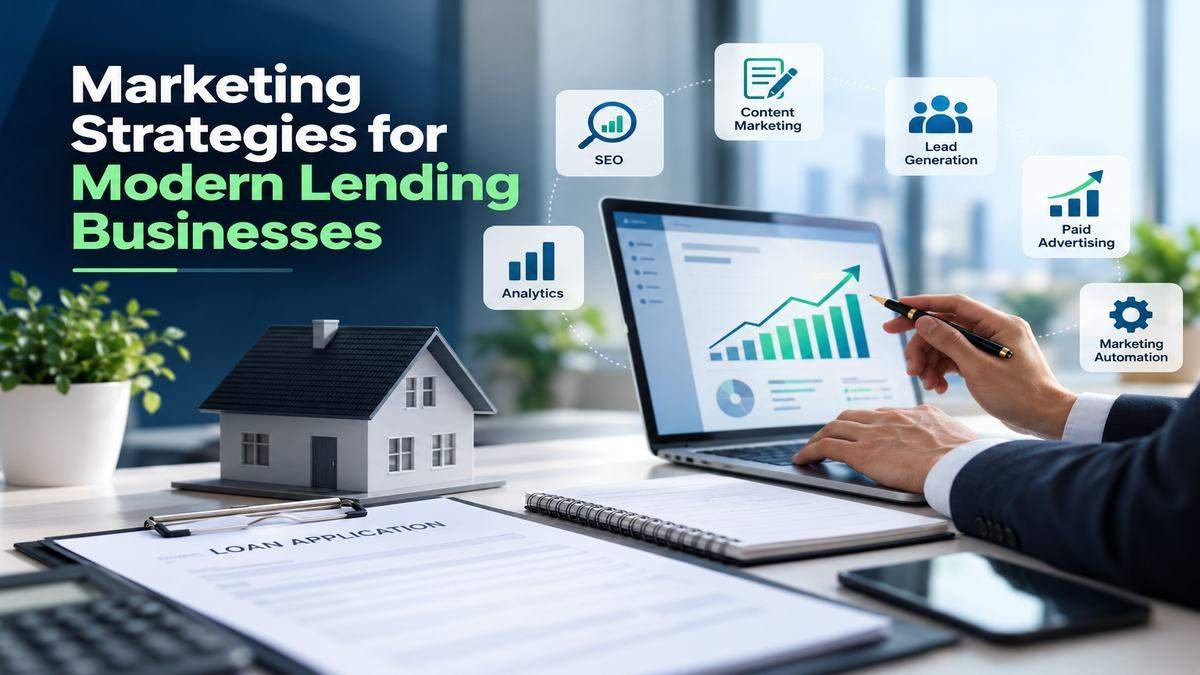
Marketing strategies for lending businesses are evolving as audiences increasingly rely on search engines, digital content, and online research to evaluate service providers. For companies operating in the U.S. lending industry, building visibility requires more than running advertising campaigns. Businesses need a coordinated digital marketing approach that attracts relevant audiences, builds credibility, and generates qualified leads.
Modern marketing strategies for lending businesses combine search engine optimization (SEO), content marketing, paid advertising, lead nurturing, and marketing analytics. When these activities work together, businesses can strengthen their online presence, improve campaign performance, and support long-term customer acquisition.
This guide explores seven practical marketing strategies for lending businesses, explains common mistakes to avoid, and outlines how an integrated digital marketing strategy can support sustainable growth.
Why Marketing Matters for Modern Lending Businesses
Competition across digital channels makes it important for lending businesses to communicate their value clearly and reach relevant audiences. Effective lending marketing supports three important objectives.
Increase online visibility. SEO, helpful content, and targeted advertising help businesses reach audiences researching relevant services.
Build credibility. Clear website information, educational resources, and consistent messaging help potential customers understand a company’s services.
Generate qualified leads. A coordinated strategy connects marketing campaigns with relevant landing pages, follow-up processes, and measurable business outcomes.
The most effective marketing strategies for lending businesses connect these objectives rather than treating each marketing channel separately. This creates a more consistent experience for audiences and helps businesses understand which activities contribute to growth.
7 Effective Marketing Strategies for Lending Businesses
1. Strengthen Your Website and SEO
A business website is often one of the first places potential customers visit when evaluating a provider. It should explain services clearly, make important information easy to find, and guide visitors toward relevant next steps.
Financial services SEO helps businesses improve organic search visibility by aligning website content with audience needs and search intent.
To strengthen your website:
- Improve technical SEO: Review crawlability, indexability, mobile usability, page speed, and broken links.
- Optimize on-page elements: Write relevant page titles, meta descriptions, headings, and image alt text.
- Target relevant keywords: Identify search terms that reflect your services and audience questions.
- Build internal links: Connect related articles, service pages, and resources with descriptive anchor text.
- Improve website usability: Make navigation, contact forms, and calls to action easy to use.
SEO is a long-term investment, so monitor organic traffic, keyword visibility, qualified enquiries, and conversion rates over time.
For companies evaluating marketing strategies for lending businesses, SEO provides a foundation for sustainable visibility and can support other channels by helping audiences find relevant information when they need it.
2. Invest in Helpful Content Marketing
Content marketing helps lending businesses answer audience questions, explain complex topics, and establish a consistent online presence. It can also support SEO by addressing relevant search intent and connecting related topics across the website.
Develop content around the questions your target audience asks during the research and evaluation process. Useful formats include educational articles, industry insights, practical guides, service explanations, and frequently asked questions.
A structured content marketing strategy should include:
- Audience-focused topics: Address genuine information needs and common questions.
- Content clusters: Organize related articles around broader themes and link them together.
- Consistent publishing: Maintain a realistic editorial calendar that prioritizes quality.
- Relevant calls to action: Direct readers to appropriate service pages or resources.
Content should provide meaningful information rather than simply repeat keywords. Accurate explanations, practical examples, and useful insights help distinguish your business from competitors.
When planning marketing strategies for lending businesses, connect content marketing with SEO and lead generation goals. This allows educational resources to support organic visibility while helping relevant visitors understand the services available.
3. Improve Visibility in AI Search
AI-powered search experiences are changing how users discover and evaluate information. Some platforms generate answers that summarize information from multiple sources rather than presenting only a traditional list of links.
AI search optimization helps businesses prepare content for these experiences while maintaining established SEO fundamentals. Although no strategy guarantees that a page will appear in an AI-generated answer, clear and trustworthy information can improve its usefulness and accessibility.
Lending businesses can strengthen their approach by:
- Answering audience questions directly.
- Using descriptive headings and logical page structures.
- Supporting factual claims with reliable sources.
- Keeping website information accurate and current.
- Connecting related topics through internal links.
- Maintaining accessible, technically sound pages.
Answer engine optimization (AEO) and generative engine optimization (GEO) support these efforts by emphasizing clear answers, relevant context, and well-organized content.
Monitor AI-related visibility where reliable data is available, but evaluate it alongside organic search performance, engagement, and qualified leads. Modern marketing strategies for lending businesses should treat AI search as part of a broader digital marketing plan, not a replacement for traditional SEO.
4. Build a Targeted Lead Generation Strategy
Lead generation is most effective when campaigns reach an appropriate audience and provide a clear path from initial interest to enquiry.
Begin by defining what makes a lead qualified for your business. Relevant criteria may include service requirements, business needs, audience characteristics, or other factors aligned with your objectives.
Next, develop campaigns and landing pages that address these needs. Each landing page should explain the relevant service, communicate its value accurately, and provide a straightforward next step.
An effective lending lead generation strategy includes:
- Identifying target audiences and their needs.
- Matching campaign messaging to relevant landing pages.
- Keeping forms clear and requesting only necessary information.
- Establishing a process for reviewing and qualifying enquiries.
- Tracking lead sources, conversion rates, and lead quality.
Avoid measuring success through enquiry volume alone. A large number of submissions may not translate into valuable business opportunities if the audience is poorly matched to the service.
Lead generation should therefore be an essential component of marketing strategies for lending businesses, supported by accurate tracking and a clear process for evaluating outcomes.
5. Use Paid Advertising Strategically
Paid advertising can help businesses reach specific audiences and test campaign messages without waiting for organic visibility to develop. However, paid advertising for lenders requires careful targeting, accurate messaging, and ongoing performance analysis.
Search advertising can be useful when audiences actively look for relevant services. Other paid channels may support brand awareness or remarketing when they match the intended audience and campaign objectives.
To improve campaign performance:
- Select keywords and audiences aligned with business goals.
- Write advertisements that accurately describe the offering.
- Match each advertisement to a relevant landing page.
- Test different messages and calls to action.
- Monitor spending, cost per lead, conversion rates, and lead quality.
Campaigns should follow applicable advertising policies and financial services requirements. Avoid misleading claims or language that implies guaranteed outcomes.
Paid advertising works best when coordinated with SEO, content marketing, and lead nurturing. This integrated approach helps businesses evaluate which channels attract relevant prospects and contribute to customer acquisition.
6. Use Marketing Automation and Lead Nurturing
Not every prospect is ready to take action after the first website visit. Lead nurturing helps businesses maintain relevant communication while prospects continue researching and evaluating their options.
Marketing automation can organize follow-ups, segment audiences, and deliver messages based on appropriate triggers or user preferences.
A practical approach includes:
- Segmenting contacts according to relevant interests or enquiry types.
- Sending timely follow-up communications.
- Sharing useful educational resources.
- Reviewing engagement to identify relevant messages.
- Respecting consent and communication preferences.
Automation should make communication more relevant rather than simply increase message volume. Each interaction should have a clear purpose and provide useful information.
Monitor engagement, responses, and downstream conversions where available. These insights help businesses refine their lead nurturing processes and improve coordination between marketing and sales teams.
For companies implementing marketing strategies for lending businesses, marketing automation can connect initial lead generation with ongoing communication and help maintain a more consistent customer journey.
7. Measure Performance and Optimize Conversions
Marketing analytics helps businesses understand which activities contribute to visibility, engagement, and qualified enquiries. Without consistent measurement, it becomes difficult to identify opportunities or allocate resources effectively.
Choose key performance indicators (KPIs) that reflect business objectives rather than tracking every available metric.
| KPI | Purpose |
| Organic search traffic | Measures visits from organic search |
| Cost per lead | Evaluates the cost of generating an enquiry |
| Lead qualification rate | Assesses the relevance of generated leads |
| Lead conversion rate | Measures how often prospects progress to the next stage |
| Customer acquisition cost | Estimates the cost of acquiring a customer |
| Landing page conversion rate | Evaluates how effectively a page drives action |
Use analytics platforms and campaign reports to compare performance across channels. Review tracking implementation regularly to ensure lead sources and conversions are recorded accurately.
Conversion rate optimization (CRO) can improve results by testing landing page layouts, calls to action, form length, and content clarity. Make changes based on evidence and assess whether they lead to more qualified enquiries.
Strong marketing strategies for lending businesses use these insights to refine campaigns, improve efficiency, and focus resources on activities that support business objectives.
Common Marketing Mistakes Lending Businesses Should Avoid
Even well-funded campaigns can underperform when marketing activities lack coordination. Common mistakes include:
- Relying on one channel: Depending entirely on paid advertising or organic search creates unnecessary exposure to changes in costs or visibility.
- Prioritizing traffic over lead quality: More visits do not automatically produce more valuable enquiries.
- Publishing content without a plan: Disconnected articles may fail to address audience questions or support relevant services.
- Ignoring conversion tracking: Incomplete data makes campaign evaluation less reliable.
- Using inconsistent messaging: Conflicting information across advertisements, landing pages, and website content can confuse audiences.
- Neglecting ongoing optimization: Campaigns and content require regular review as audience behavior changes.
Avoiding these mistakes requires clear goals, consistent measurement, and a willingness to improve the strategy based on performance data.
How to Build an Integrated Lending Marketing Strategy
Successful marketing strategies for lending businesses connect individual channels through shared goals and consistent reporting.
Start by defining your target audience, business objectives, and desired marketing outcomes. Audit your website and existing campaigns to identify technical issues, content gaps, and opportunities to improve conversions.
Next, prioritize activities based on audience needs, available resources, and business value. Coordinate SEO, content marketing, paid advertising, and lead nurturing so each activity supports the wider customer journey.
Finally, establish a reporting process that connects marketing metrics with qualified enquiries and business outcomes. Review results regularly and adjust priorities as performance data reveals new opportunities.
Strengthen Your Lending Marketing With NWT Marketing
Modern lending businesses need more than individual campaigns to build a sustainable digital presence. They need coordinated marketing strategies that connect search visibility, useful content, lead generation, and performance measurement.
NWT Marketing supports businesses operating in the lending industry through digital marketing services that include SEO, content marketing, paid advertising, lead generation, marketing analytics, and conversion rate optimization.
By aligning these services with clear business goals, companies can improve how they reach audiences, evaluate campaign performance, and develop more effective marketing processes.
Ready to strengthen your digital marketing strategy? Contact NWT Marketing to discuss an approach tailored to your business objectives.
FAQs
What are the most effective marketing strategies for lending businesses?
Effective marketing strategies for lending businesses include SEO, content marketing, targeted paid advertising, lead generation, lead nurturing, and marketing analytics. The right combination depends on the company’s audience, objectives, and resources.
How can lending businesses generate more qualified leads?
Businesses can improve lead generation by defining qualification criteria, targeting relevant audiences, creating focused landing pages, and measuring lead quality rather than relying solely on enquiry volume.
How does SEO support lending marketing?
SEO helps businesses improve organic visibility for relevant searches. Technical improvements, useful content, and strong internal linking can attract relevant visitors and guide them toward appropriate services.
Is content marketing effective for lending businesses?
Content marketing can answer audience questions, support organic visibility, and build familiarity with a business. Its effectiveness depends on content quality, audience relevance, and how well it supports broader marketing goals.
Which marketing KPIs should lending businesses track?
Useful KPIs include organic traffic, cost per lead, lead qualification rate, landing page conversion rate, customer acquisition cost, and campaign conversion rates. Select metrics that reflect specific business objectives.