
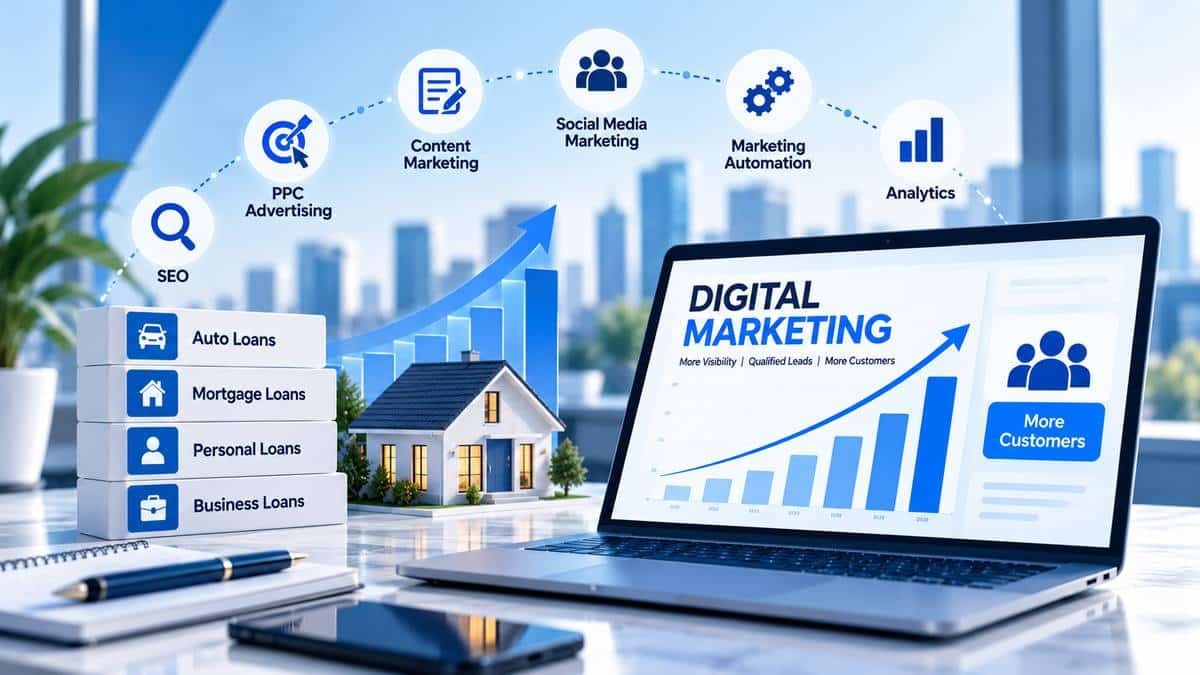
Digital marketing plays an important role in helping U.S. lending companies attract prospective customers, improve online visibility, and generate qualified leads. As consumers increasingly research financial products online, lenders need effective digital marketing strategies to reach relevant audiences and compete in a changing marketplace.
From search engine optimization (SEO) and pay-per-click (PPC) advertising to content marketing and marketing automation, digital marketing gives lending companies multiple ways to connect with prospective customers throughout their decision-making journey.
However, successful digital marketing involves more than increasing website traffic. Lending companies also need to attract relevant prospects, optimize conversion rates, improve lead quality, and measure the performance of their marketing campaigns.
In this guide, we’ll explain how digital marketing helps lending businesses reach more customers, which channels can support customer acquisition, and how to build a strategy that aligns with measurable business goals.
Why Digital Marketing Matters for Lending Companies
The U.S. lending industry is competitive, and prospective customers can research providers, compare financial products, and evaluate their options online. Lending companies need a strong digital presence to remain visible when potential customers search for relevant information.
A well-planned digital marketing strategy helps lenders connect with these audiences through organic search, paid advertising, educational content, and conversion-focused website experiences.
Effective digital marketing can help lending companies:
- Improve visibility in relevant search results.
- Reach prospective customers through targeted advertising.
- Generate qualified leads from relevant audiences.
- Build credibility through useful and accurate content.
- Improve website conversion rates.
- Measure customer acquisition costs and campaign performance.
Financial services marketing requires a clear understanding of the audience, the products being promoted, and the information prospective customers need before submitting an inquiry.
For consumer lending companies, digital marketing should communicate product information accurately, address common questions, and guide visitors toward appropriate next steps. This approach helps connect marketing activity with customer needs rather than focusing solely on traffic volume.
7 Digital Marketing Strategies That Help Lending Businesses Reach More Customers
An effective digital marketing plan combines channels that work together to attract relevant audiences, build trust, and convert interest into qualified inquiries.
1. Search Engine Optimization for Long-Term Visibility
Search engine optimization is a core component of digital marketing for lending companies. SEO helps websites improve their visibility in organic search results when prospective customers research relevant financial products or services.
For example, someone researching auto lending providers or learning about an application process may begin with a search engine. Relevant, well-optimized pages can help lending companies become more discoverable during this research stage.
A practical SEO strategy should include:
- Researching keywords relevant to the company’s products and audience.
- Creating useful service pages that explain products and requirements accurately.
- Publishing educational content that answers common questions.
- Improving website speed, mobile usability, and technical accessibility.
- Building relevant internal links between related pages.
- Monitoring organic impressions, clicks, rankings, and conversions.
For online lenders, SEO can support visibility across a broad range of relevant searches. However, rankings alone do not guarantee qualified leads. Pages must also provide useful information and make the next step clear.
Integrating SEO into a broader digital marketing strategy helps lending companies build organic visibility while supporting other customer acquisition activities.
2. PPC Advertising for Targeted Customer Acquisition
Pay-per-click advertising allows lending companies to promote their products through paid placements on search engines and other advertising platforms. It can complement SEO by providing another way to reach audiences searching for relevant information.
PPC is particularly useful when campaigns have clearly defined objectives, relevant targeting, and landing pages designed around the advertised product.
For example, a lending company could create a campaign around a specific consumer lending product and direct interested visitors to a dedicated landing page. The marketing team could then evaluate completed inquiries and lead quality rather than measuring success through clicks alone.
Important considerations for PPC digital marketing include:
- Organizing campaigns by product and search intent.
- Selecting relevant keywords and negative keywords.
- Writing accurate, specific ad copy.
- Matching landing page content to each advertisement.
- Tracking cost per lead and cost per qualified lead.
- Reviewing conversion data to identify opportunities for improvement.
Lending-related advertising may be subject to platform-specific restrictions and applicable laws. Campaigns should be reviewed against relevant advertising policies before launch.
3. Content Marketing That Builds Trust
Content marketing helps lending companies answer questions, explain products, and demonstrate expertise before prospective customers submit an inquiry.
As part of a digital marketing strategy, content can support SEO, strengthen brand awareness, and provide useful information throughout the customer journey.
Relevant content formats include educational articles, product explanations, frequently asked questions, comparison guides, and application process information.
For example, a company offering auto lending products could publish an article explaining the information commonly requested during an application. The article could answer common questions and link readers to a relevant product page.
To make content marketing more effective:
- Address genuine questions from the target audience.
- Explain product terms and processes clearly.
- Avoid unsupported claims and misleading promises.
- Link to relevant service pages and supporting articles.
- Keep information accurate and up to date.
- Include appropriate calls to action.
Content marketing also supports the wider digital marketing ecosystem by creating useful destinations for organic visitors and paid campaign traffic.
For lending companies, credibility is essential. Content should help readers understand their options without promising approval, guaranteed funding, or specific financial outcomes.
4. Social Media Marketing for Brand Awareness
Social media marketing gives lending companies another channel for distributing content, maintaining brand visibility, and communicating with relevant audiences.
LinkedIn may be useful for professional relationships and business partnerships, while other social platforms may support consumer-facing brand awareness depending on the company’s audience and objectives.
As part of a digital marketing plan, social media activities may include sharing educational resources, publishing company updates, answering general questions, and promoting relevant website content.
However, social engagement should not be the only performance measure. A campaign that generates many likes but few relevant inquiries may contribute less to customer acquisition than a smaller campaign that attracts qualified prospects.
Choose platforms based on audience behavior, establish clear campaign objectives, and measure the outcomes that matter to the business.
5. Landing Page Optimization to Increase Conversions
Digital marketing campaigns can attract visitors, but a poorly designed landing page may prevent those visitors from taking the next step.
Landing page optimization helps lending companies improve the experience between the first interaction and the submission of an inquiry.
An effective landing page should include:
- A clear headline aligned with the visitor’s intent.
- A concise explanation of the product or service.
- Accurate descriptions of relevant terms and requirements.
- A visible and appropriate call to action.
- A simple form requesting necessary information.
- Mobile-friendly design and accessible navigation.
- Clear privacy information and appropriate disclosures.
For example, a PPC campaign promoting a particular lending product should direct visitors to a relevant landing page rather than a generic homepage.
Marketing teams should test meaningful elements such as headlines, form length, page layout, and calls to action. Evaluate changes using conversion rates and lead quality instead of assuming that more form submissions automatically produce better results.
Combining conversion rate optimization with digital marketing analytics helps lenders identify which website improvements contribute to stronger acquisition performance.
6. Marketing Automation and Lead Nurturing
Not every prospective customer is ready to take the next step when they first visit a website. Marketing automation helps lending companies manage follow-up communications, organize leads, and deliver relevant information according to a prospect’s interests and stage in the journey.
When integrated with digital marketing campaigns, automation can help teams maintain consistent communication and reduce repetitive manual tasks.
Practical applications include:
- Establishing clear lead qualification criteria.
- Sending timely and relevant follow-up communications.
- Segmenting audiences using appropriate customer information.
- Managing consent-aware communication processes.
- Defining handoffs between marketing and sales teams.
- Reporting on lead progression and conversion outcomes.
For example, a prospect who submits an inquiry may receive relevant follow-up information while the appropriate team member is notified to review the request.
Automation does not replace human oversight. Lending companies should ensure their processes respect applicable privacy requirements and avoid misleading or inappropriate communications.
7. Marketing Analytics to Improve Performance
Marketing analytics helps lending companies understand which digital marketing channels contribute to customer acquisition and where campaign improvements are needed.
Without reliable tracking, teams may prioritize inexpensive clicks while overlooking campaigns that generate more qualified prospects.
A useful digital marketing reporting framework should include:
- Website sessions and traffic sources.
- Organic search impressions and clicks.
- Landing page conversion rates.
- Total leads and qualified leads.
- Cost per lead and cost per qualified lead.
- Lead-to-customer conversion rate.
- Customer acquisition cost.
- Revenue or other business outcomes where appropriate data is available.
Use analytics platforms, advertising reports, and CRM data to connect marketing activity with downstream results.
This makes it easier to allocate budgets based on evidence, identify weaknesses in the acquisition funnel, and improve marketing efficiency over time.
Loan Lead Generation: Prioritize Quality Over Volume
Loan lead generation is an important objective for companies seeking to expand their customer base. However, generating a high volume of inquiries does not necessarily translate into better business results.
A lead may be incomplete, duplicated, irrelevant to the company’s products, or unsuitable for the next stage of the process.
Digital marketing teams should therefore evaluate lead quality alongside lead volume.
Consider these factors:
Relevance: Does the inquiry relate to a product the company offers?
Completeness: Has the prospect provided the information required for appropriate follow-up?
Engagement: Has the prospect taken a meaningful action indicating interest?
Timeliness: Can the sales or customer support team respond while the inquiry remains relevant?
Conversion outcomes: Which channels consistently contribute to meaningful downstream results?
Companies evaluating the best mortgage leads or other product-specific lead sources should apply similar principles. Lead value depends on relevance, accuracy, permitted use, and contribution to business outcomes not simply the price paid.
When comparing top mortgage lead generation companies or other third-party providers, review lead sourcing methods, consent practices, freshness, exclusivity terms, duplication policies, and reporting capabilities.
Integrating these checks into a digital marketing and lead management strategy helps businesses make more informed acquisition decisions.
How to Build an Effective Digital Marketing Strategy
A successful digital marketing strategy begins with clear business objectives, a defined audience, and a practical measurement framework.
Define Your Audience and Acquisition Goals
Identify the products being promoted, the intended audience, and the outcomes each campaign should support.
Establish measurable goals for qualified inquiries, conversion rates, and acquisition costs. Targets should reflect actual business economics and historical performance rather than unsupported industry averages.
Select Channels Based on Customer Intent
Use SEO and content marketing to build organic visibility, PPC to reach relevant search audiences, and landing page optimization to convert interest into inquiries.
Social media and marketing automation can complement these channels when they align with the audience and acquisition process.
Not every company needs to invest equally in every channel. Prioritize digital marketing activities according to business objectives, available resources, and measurable opportunities.
Measure, Test, and Improve
Create a reporting process that connects marketing metrics with lead quality and business outcomes.
Review campaign performance regularly, investigate changes in conversion rates, and test improvements systematically.
For example, if a campaign generates substantial traffic but few qualified inquiries, review keyword intent, ad messaging, landing page relevance, and lead qualification criteria before increasing the budget.
This continuous improvement process helps lending companies focus on digital marketing activities that contribute to meaningful business outcomes.
Common Digital Marketing Mistakes Lending Companies Should Avoid
Even a well-funded digital marketing campaign can underperform when its strategy lacks focus or reliable measurement.
Focusing on traffic instead of qualified leads. More visitors do not necessarily mean more valuable inquiries.
Using generic landing pages. Pages that do not match the visitor’s search intent can reduce conversions.
Ignoring lead follow-up. Delayed or inconsistent responses can weaken the customer experience.
Making unsupported marketing claims. Promises of guaranteed approval, guaranteed leads, or guaranteed results can mislead audiences and create compliance risks.
Measuring channels in isolation. SEO, PPC, content marketing, and automation can work together throughout the customer journey.
Neglecting advertising requirements. Lending-related campaigns should be reviewed against applicable laws, platform policies, and disclosure requirements.
Avoiding these mistakes helps marketing teams build a more consistent, transparent, and measurable approach to customer acquisition.
Conclusion
Digital marketing helps lending companies reach prospective customers, improve brand visibility, and strengthen customer acquisition. By combining SEO, PPC advertising, content marketing, landing page optimization, marketing automation, and analytics, lenders can connect with relevant audiences and generate qualified leads.
An effective digital marketing strategy goes beyond increasing website traffic. It focuses on attracting the right prospects, improving conversion rates, and measuring performance against meaningful business objectives.
Build Your Digital Marketing Strategy With NWT Marketing
NWT Marketing helps businesses in the U.S. lending industry improve their digital marketing performance through SEO, PPC, lead generation, content marketing, marketing automation, and conversion rate optimization.
Whether your goal is to strengthen online visibility, improve lead generation, or optimize customer acquisition, our digital marketing solutions help your team identify opportunities and build a strategy aligned with your business objectives.
Ready to improve your digital marketing results? Contact NWT Marketing to develop a strategy that helps your lending business reach more prospective customers and generate qualified leads.
FAQs
What is digital marketing for lending businesses?
Digital marketing for lending businesses uses online channels such as SEO, paid advertising, content marketing, social media, and marketing automation to improve visibility, reach prospective customers, and generate qualified inquiries.
Which digital marketing channels work best for lenders?
The best digital marketing channels depend on a company’s products, audience, budget, and acquisition goals. SEO can support long-term organic visibility, PPC can target relevant searches, and content marketing can answer customer questions. Analytics helps determine which combination performs most effectively.
How can digital marketing improve customer acquisition?
Digital marketing can improve customer acquisition by helping companies reach relevant audiences, optimize landing pages, qualify inquiries, and measure campaign performance. Combining these activities can help teams identify opportunities to improve lead quality and conversion rates.
What is the difference between lead volume and lead quality?
Lead volume measures how many inquiries a campaign generates. Lead quality reflects how relevant and useful those inquiries are to the company’s acquisition process. Evaluating both helps businesses understand whether marketing activity is contributing to meaningful outcomes.
Does financial advisor marketing use the same strategies as lender marketing?
Both can use SEO, content marketing, paid advertising, and analytics. However, financial advisor marketing often focuses on professional services and client relationships, while lender marketing typically centers on lending products, application-related journeys, and customer acquisition. Each digital marketing strategy should reflect the business’s audience, services, and applicable requirements.