
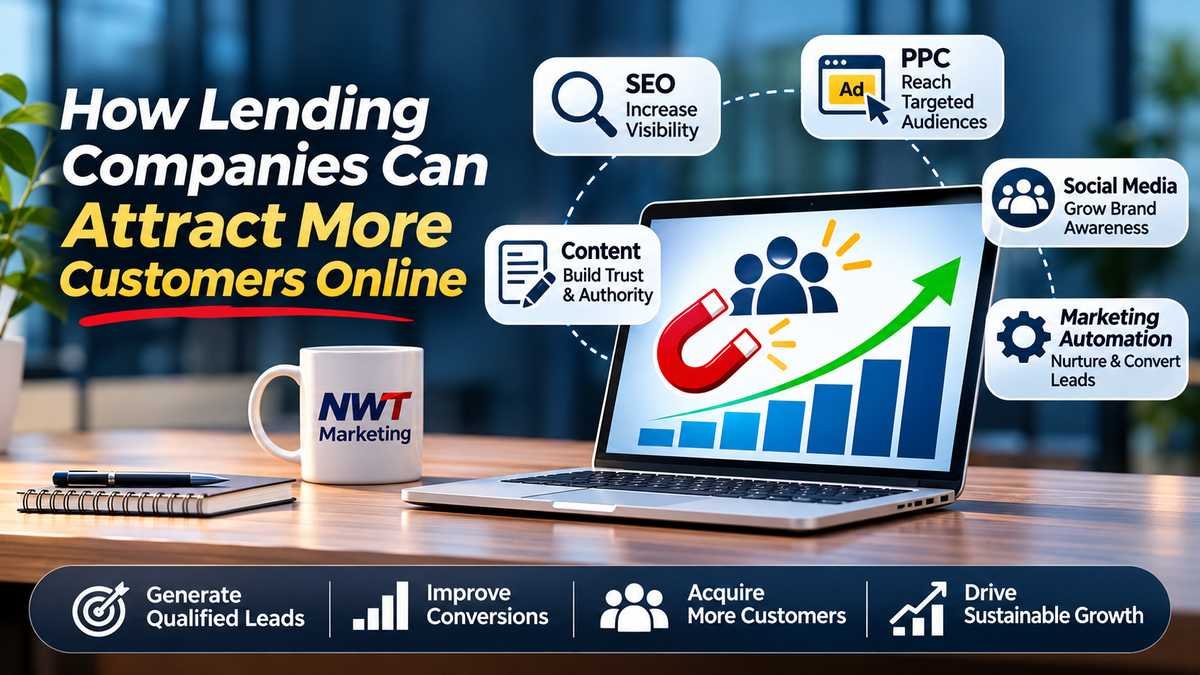
The way potential customers research lending companies has changed. Before contacting a business, many people search online, compare available options, read reviews, and evaluate whether a company appears trustworthy. For lending businesses, this creates an important opportunity to reach potential customers through digital channels.
However, simply having a website or running occasional advertising campaigns is not enough. Companies need a coordinated marketing approach that improves visibility, communicates value, and makes it easier for interested prospects to take the next step.
Understanding how to attract customers online requires more than increasing website traffic. It involves reaching relevant audiences, generating qualified leads, improving conversion opportunities, and measuring the performance of every marketing channel.
In this guide, we examine practical customer acquisition strategies that lending companies can use to strengthen their digital presence and build a more consistent process for generating business opportunities.
Why Online Customer Acquisition Matters for Lending Companies
Potential customers often research financial products and lending providers before making contact. They may use search engines, visit company websites, compare information, and look for answers to specific questions.
This behavior makes digital marketing an important part of modern lending company marketing. A strong online acquisition strategy helps businesses connect with people who are actively researching relevant services.
There are three important reasons to invest in digital customer acquisition.
1. Reach Potential Customers at the Right Time
Search engines and paid advertising platforms allow lending businesses to connect with audiences based on their interests, searches, and online behavior.
For example, a person searching for information about business lending options may be actively comparing providers. Relevant website content and targeted campaigns can help a company appear during this research process.
Using the right digital marketing channels makes it easier to reach potential customers when they are looking for relevant information.
2. Improve Lead Quality and Conversion Opportunities
More website visitors do not automatically mean more business opportunities. A successful strategy focuses on attracting relevant prospects rather than generating traffic without a clear purpose.
Companies can improve lead quality by targeting relevant keywords, creating useful content, and developing landing pages that match the visitor’s expectations.
This approach helps businesses attract customers online who are more likely to be interested in their services.
3. Build a More Predictable Acquisition Process
Relying on a single marketing channel can make customer acquisition difficult to manage. Search visibility, paid advertising, content marketing, and lead nurturing can work together to create a more consistent acquisition process.
By monitoring performance across these channels, businesses can identify what generates qualified leads and allocate resources more effectively.
7 Effective Ways to Attract More Customers Online
A strong acquisition strategy combines multiple marketing activities. The following approaches can help lending companies improve their visibility, connect with relevant audiences, and generate more qualified opportunities.
1. Optimize Your Website for Customer Acquisition
A company’s website is often one of the first places potential customers visit when researching its services. It should communicate what the business offers, who it serves, and how visitors can get in touch.
Start by reviewing the website’s structure and user experience.
Important areas to optimize include:
- Mobile responsiveness: Ensure pages work properly across smartphones, tablets, and desktop devices.
- Page speed: Improve loading performance to reduce unnecessary friction.
- Navigation: Organize service pages and supporting information clearly.
- Calls to action: Use clear prompts that explain what visitors should do next.
- Landing pages: Create dedicated pages that match specific campaigns and audience needs.
- Contact forms: Keep forms straightforward and request only relevant information.
Website optimization is not only about appearance. It should support the visitor’s journey from initial research to meaningful engagement.
A professional, easy-to-use website can help lending businesses build credibility and attract customers online more effectively.
2. Use SEO to Reach High-Intent Audiences
Search engine optimization (SEO) helps lending companies improve their visibility when potential customers search for relevant services and information.
Unlike paid advertising, organic search can continue generating visits after content begins ranking. However, sustainable SEO requires consistent work across technical performance, content quality, keyword targeting, and website authority.
A practical SEO strategy should include:
- Researching keywords relevant to the company’s services.
- Creating dedicated service pages for important offerings.
- Publishing informative articles that answer customer questions.
- Improving title tags, meta descriptions, and internal links.
- Fixing technical SEO issues that affect crawling and indexing.
- Monitoring organic search performance through Google Search Console and analytics tools.
Search intent is particularly important. A page should provide information that matches what users are actually looking for rather than simply repeating keywords.
For lending businesses, financial services SEO can support long-term organic lead generation by connecting relevant searches with useful website pages.
3. Create Content That Answers Customer Questions
Content marketing gives lending companies an opportunity to demonstrate expertise, explain their services, and address common questions before prospects make contact.
Rather than publishing articles without a clear direction, businesses should develop content around the topics their audiences regularly research.
Useful content formats include:
- Educational blog articles.
- Frequently asked questions.
- Service explanations.
- Industry guides.
- Comparison articles.
- Short educational videos.
- Downloadable resources.
For example, a company serving business customers could publish educational content about preparing for a lending application, understanding eligibility requirements, or comparing different business lending options.
Each article should have a clear purpose and connect naturally to relevant service pages or conversion opportunities.
Consistent, helpful content can strengthen search visibility, support brand credibility, and help companies attract customers online without relying exclusively on paid campaigns.
4. Launch Targeted PPC Advertising Campaigns
Pay-per-click (PPC) advertising can help lending businesses reach relevant audiences through paid search and other advertising platforms.
Unlike SEO, which generally takes time to build organic visibility, PPC campaigns can begin generating traffic once they are approved and launched. However, performance depends on targeting, messaging, competition, landing page quality, and budget management.
An effective PPC advertising strategy should include:
- Selecting keywords that reflect relevant search intent.
- Organizing campaigns around specific services.
- Writing clear and relevant ad copy.
- Creating dedicated landing pages.
- Tracking conversions and lead quality.
- Reviewing search terms and excluding irrelevant traffic.
- Monitoring cost per lead and cost per acquisition.
Lending-related advertising may also be subject to platform-specific financial services policies and applicable advertising requirements. Businesses should review relevant rules before launching campaigns.
The objective is not simply to generate clicks. It is to reach relevant prospects and create meaningful conversion opportunities.
5. Use Social Media to Build Brand Awareness
Social media marketing can help lending companies maintain visibility, communicate with their audiences, and share useful information.
The most suitable platforms depend on the company’s target market and business objectives. For B2B lending businesses, LinkedIn may be useful for professional communication and industry-related content. Other platforms may support broader brand awareness depending on the audience.
A consistent social media strategy can include:
- Sharing educational articles and guides.
- Publishing company updates.
- Explaining services through short posts.
- Sharing relevant industry insights.
- Responding professionally to comments and questions.
- Promoting useful resources from the company website.
Social media should not be treated as an isolated activity. Connecting social posts with website content and other marketing campaigns can create a more consistent brand experience.
6. Improve Landing Pages and Conversion Rates
Generating traffic is only one part of customer acquisition. Businesses also need landing pages that encourage relevant visitors to take action.
Conversion rate optimization (CRO) focuses on identifying and removing barriers that prevent visitors from completing desired actions.
For lending companies, useful improvements may include:
- Writing headlines that clearly explain the page’s purpose.
- Matching landing page content with the advertising message.
- Making forms easier to complete.
- Displaying relevant trust signals.
- Improving mobile usability.
- Testing different calls to action.
- Removing unnecessary distractions.
Businesses should use analytics and testing to understand how visitors interact with landing pages instead of relying entirely on assumptions.
A well-optimized landing page can help attract customers online while improving the percentage of visitors who become leads.
7. Implement Lead Nurturing and Marketing Automation
Not every prospect is ready to contact a company immediately. Some visitors need additional information or time to evaluate their options.
Lead nurturing helps businesses maintain communication with prospects throughout the decision-making process.
Marketing automation can support this process through:
- Automated email sequences.
- Follow-up reminders.
- Lead segmentation.
- Personalized content distribution.
- CRM-based lead management.
- Campaign performance reporting.
For example, someone who downloads an educational guide may receive a relevant follow-up email with additional resources. The communication should remain useful, appropriate, and consistent with applicable consent and privacy requirements.
When combined with effective lead generation campaigns, nurturing can help businesses maintain engagement and improve the chances of converting qualified prospects.
Which Digital Marketing Channels Should Lending Companies Prioritize?
Not every company needs to invest equally in every channel. The right combination depends on its target audience, available resources, competitive environment, and business objectives.
| Marketing channel | Primary purpose | Potential benefit |
| SEO | Improve organic search visibility | Sustainable organic traffic |
| PPC advertising | Reach relevant search audiences | Faster campaign exposure |
| Content marketing | Educate potential customers | Trust and engagement |
| Social media | Build brand awareness | Audience engagement |
| Email marketing | Maintain prospect communication | Lead nurturing |
| Marketing automation | Manage repetitive marketing tasks | More efficient follow-up |
The most effective approach is usually an integrated strategy rather than treating every channel as a separate activity.
For example, SEO and content marketing can generate organic traffic, while PPC can support specific campaigns. Email marketing and automation can then help maintain communication with interested prospects.
This combination can help lending companies attract customers online through multiple touchpoints instead of depending on one source of traffic.
How to Improve Lead Quality and Customer Conversion
A successful acquisition strategy should focus on the quality of opportunities generated, not just their quantity.
Lending companies can improve their lead generation process by following three important practices.
Define Your Ideal Customer Profile
Identify the audiences the business is best positioned to serve. Consider factors such as customer needs, service requirements, geographic coverage, and relevant eligibility considerations.
A clear audience definition helps marketing teams select more relevant keywords, create better content, and improve campaign targeting.
Align Marketing Messages With Customer Intent
The information presented in an advertisement or search result should match the content on the destination page.
If a visitor clicks an advertisement about a particular service, the landing page should provide relevant information about that service. Inconsistent messaging can create confusion and reduce conversion opportunities.
Simplify the Conversion Journey
Review the steps visitors must complete before becoming leads. Remove unnecessary form fields, improve page navigation, and make contact options easy to find.
Businesses should also ensure that incoming leads are routed to the appropriate team and followed up within a reasonable timeframe.
How to Measure Customer Acquisition Performance
Tracking performance allows lending companies to understand which marketing activities contribute to business objectives.
Instead of evaluating campaigns based only on traffic or impressions, businesses should monitor metrics that connect marketing activity with meaningful outcomes.
| Metric | What it measures |
| Organic traffic | Visitors arriving through unpaid search results |
| Cost per lead (CPL) | Marketing cost associated with generating a lead |
| Cost per acquisition (CPA) | Cost associated with achieving a defined acquisition |
| Lead-to-customer conversion rate | Percentage of leads that become customers |
| Customer acquisition cost (CAC) | Average cost of acquiring a customer |
| Marketing ROI | Return generated relative to marketing investment |
Google Analytics 4, Google Search Console, advertising platform reports, and CRM systems can help teams collect and analyze this information.
Businesses should establish clear conversion definitions and consistent tracking before comparing campaign performance. This makes it easier to identify which channels generate qualified opportunities and where improvements are needed.
Regular reporting also helps marketing teams make better decisions about budgets, targeting, and campaign priorities.
Build a More Effective Customer Acquisition Strategy With NWT Marketing
Building a stronger digital acquisition process requires more than launching individual campaigns. Lending companies need a coordinated strategy that connects website optimization, SEO, PPC, content marketing, lead generation, and performance measurement.
The right approach depends on business goals, audience behavior, competition, and available resources. By continuously evaluating performance and improving the customer journey, companies can build a more sustainable foundation for digital growth.
NWT Marketing helps businesses operating in the lending industry develop digital marketing strategies focused on search visibility, qualified lead generation, customer acquisition, and measurable campaign performance.
If your business wants to attract customers online more effectively, a structured marketing strategy can help connect your services with relevant audiences and create stronger opportunities for growth.
FAQs
1. How can lending companies attract more customers online?
Lending companies can use SEO, content marketing, PPC advertising, social media, and optimized landing pages to reach relevant audiences. Combining these channels with lead nurturing and performance tracking can improve the overall acquisition process.
2. What is the best digital marketing channel for lending businesses?
There is no single best channel for every business. SEO can support long-term organic visibility, PPC can provide targeted campaign exposure, and content marketing can educate potential customers. The right combination depends on the company’s audience and objectives.
3. How does SEO help lending companies generate leads?
SEO improves a company’s visibility in relevant search results. By targeting appropriate keywords and publishing useful content, businesses can reach people researching relevant services and direct them to pages designed to generate inquiries.
4. How can lending businesses improve lead quality?
Businesses can improve lead quality by defining their target audiences, using relevant keywords, creating focused landing pages, setting appropriate qualification criteria, and tracking which campaigns generate meaningful opportunities.
5. Why is conversion rate optimization important for lenders?
Conversion rate optimization helps businesses identify problems in the website experience and improve the likelihood that visitors will complete desired actions. Better landing pages, clearer messaging, and simpler forms can support stronger conversion performance.
6. How should lending companies measure online marketing success?
They should monitor organic traffic, qualified leads, conversion rates, cost per lead, customer acquisition cost, and marketing ROI. These metrics provide a clearer picture of marketing performance than website traffic alone.