
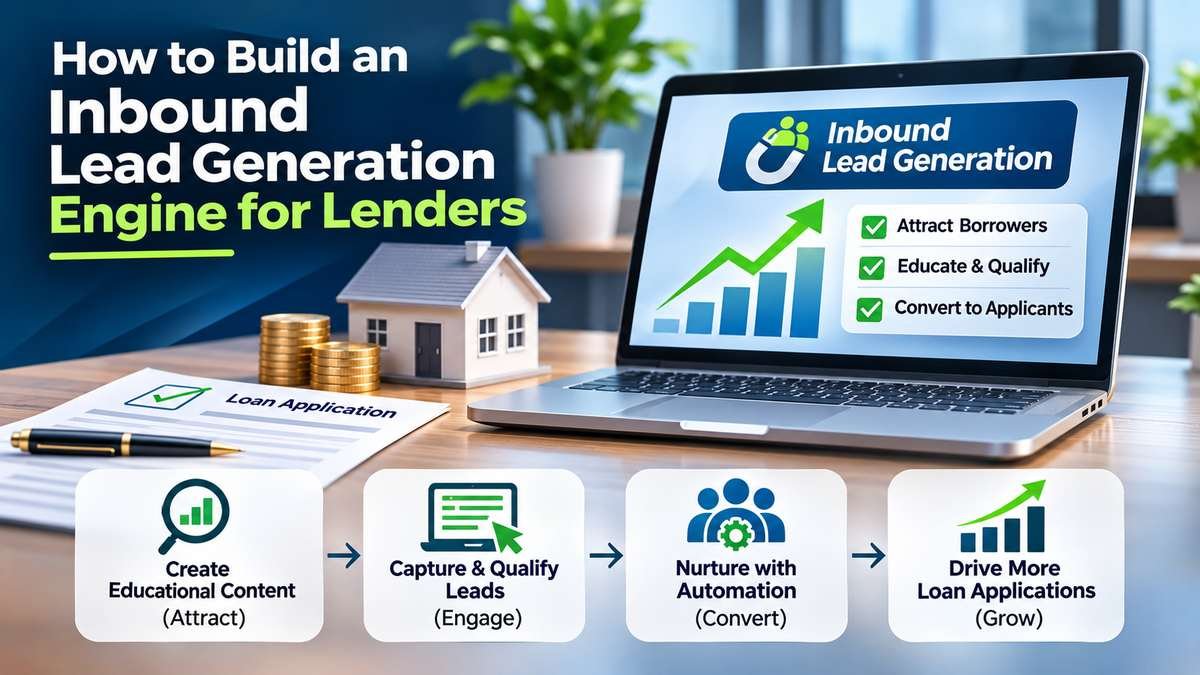
Consumer lending operates in one of the most competitive customer acquisition environments in the United States. For lending company owners, marketing directors, digital growth leaders, and customer acquisition teams, relying exclusively on paid search campaigns or purchasing third-party lead aggregator lists presents significant long-term business challenges. Scaling paid channels often leads to escalating cost per acquisition metrics, fluctuating lead quality, and intense bidding competition against national financial institutions.
While paid advertising provides immediate volume, performance ad channels capture user intent primarily at the final moment of decision and at a premium price. Establishing a comprehensive inbound lead generation strategy offers consumer lenders a scalable, long-term framework to attract, educate, and convert prospective borrowers organically. By publishing targeted educational content around borrower financial needs, lending businesses can cultivate trust, improve lead quality for lending businesses, and establish a predictable pipeline of pre-qualified loan applicants.
Step 1: Shift from Outbound Push to Inbound Educational Engagement
Historically, digital financial customer acquisition relied heavily on direct-mail campaigns, high-pressure push advertising, or short-form landing pages designed to capture contact details without providing meaningful context. Today’s financial consumers behave differently they conduct extensive online research before ever submitting a credit or loan application.
Deploying a structured inbound lead generation model transforms your acquisition framework from disruptive selling into value-driven borrower engagement. Instead of competing solely on expensive, high-bid search keywords, lenders leverage structured digital marketing channels to educate and pre-qualify prospective borrowers at every stage of their decision-making process.
This buyer journey spans three critical stages:
- Top of the Funnel (ToFu): Attracting broad organic search traffic through accessible financial education, debt management tips, and credit guidance.
- Middle of the Funnel (MoFu): Qualifying borrower intent using interactive rate calculators, eligibility checklists, and downloadable comparison guides.
- Bottom of the Funnel (BoFu): Converting pre-qualified loan applicants through streamlined, low-friction landing pages and application walkthroughs.
Integrating inbound lead generation into your broader growth model delivers several core commercial advantages for consumer lenders:
- Sustained Efficiency in Cost Per Acquisition: High-quality organic content functions as a compounding digital asset, generating qualified leads month after month without continuous pay-per-click spend.
- Improved Conversion Rate Optimization: Well-educated loan applicants understand pre-qualification guidelines before applying, which boosts downstream conversion rate optimization metrics.
- Higher Application Completion Rates: Providing upfront clarity regarding loan terms, interest structures, and repayment responsibilities builds authentic trust with prospective borrowers, reducing form drop-off.
Step 2: Build Intent-Driven Topic Clusters and High-Value Content Assets
To drive consistent loan lead generation organically, consumer lenders must structure their website content around targeted topic clusters rather than publishing disconnected blog posts.
Partnering with specialized experts in b2b marketing financial services ensures your digital assets establish domain authority and rank for high-intent search queries:
Core Pillar Pages
Build comprehensive resource pages around primary loan products (e.g., Personal Loans, Debt Consolidation Loans, or Home Equity Solutions). These central hubs explain loan features, interest rate structures, and eligibility requirements in complete detail.
Supporting Cluster Articles
Surround pillar pages with targeted cluster articles addressing specific borrower questions, such as:
- How Debt Consolidation Impact Your Credit Score
- Personal Loans vs. Credit Card Balance Transfers: Which Saves More?
- What Documents Are Required for Online Loan Approval?
Interactive Lead Capture Assets
Financial consumers appreciate immediate utility. Incorporate interactive widgets such as loan payment calculators, amortization schedulers, or rate estimators that deliver personalized value in exchange for contact details. An interactive calculator requiring an email address to send detailed savings reports serves as a high-converting inbound lead generation asset.
By establishing topical authority across organic search, lenders position their brand as a trusted authority in b2b financial services, attracting prospective borrowers who are actively researching credit solutions.
Step 3: Implement Strategic Pre-Screening to Maximize Lead Quality
A common misconception regarding inbound lead generation is that generating higher organic traffic automatically leads to higher revenue. Without proper qualification mechanisms, attracting broad traffic can overload underwriting teams with non-viable inquiries.
To maintain high lead quality for lending businesses, lenders must incorporate strategic pre-screening filters directly into their digital inbound workflows.
Implementing pre-qualification screening optimizes your inbound funnel:
- Clear Eligibility Messaging: Explicitly state minimum credit score tiers, income benchmarks, and geographic licensing parameters directly on content pages and form headers.
- Multi-Step Form Friction: Utilize multi-step qualification forms that ask targeted questions regarding employment status, loan purpose, and monthly debt obligations before requesting contact details.
- Soft Credit Pull Integration: Integrate soft credit inquiries into your preliminary screening tools. This allows your team to verify applicant eligibility instantly without impacting the user’s credit score or adding manual underwriting labor.
Adding strategic qualification steps improves downstream conversion rate optimization by delivering pre-screened, high-intent loan applicants directly to your sales and underwriting pipeline.
Step 4: Optimize Content Pages for Conversion Rate Optimization and AI Search
Attracting site visitors through inbound lead generation is only half the battle; converting readers into active loan applicants requires specialized conversion rate optimization techniques tailored to financial platforms.
Contextual Calls-to-Action (CTAs)
Avoid placing generic “Apply Now” buttons across broad educational topics. Align your CTA directly with the reader’s immediate search intent:
- On a debt consolidation guide: “Calculate Your Monthly Savings with a Consolidation Loan.”
- On an eligibility checklist: “Check Your Prequalification Criteria in 2 Minutes.”
Optimization for AI Search (AEO and GEO)
Modern borrowers increasingly use AI-driven search engines (like ChatGPT, Gemini, and Perplexity) to evaluate credit options. Ensure your inbound lead generation content features direct answer summaries, structured comparisons, and clear heading hierarchies (H2, H3) framed around natural financial questions.
Trust Indicators and Security Seals
Financial transactions carry natural user anxiety. Display prominent bank-level security badges, SSL encryption notices, and clear regulatory compliance statements near all lead capture forms. Transparency regarding credit inquiries drastically increases form submissions from prospective borrowers.
Step 5: Automate Lead Nurturing and CRM Workflows
Not every borrower who engages with your inbound lead generation content is ready to submit a full loan application on day one. Many require ongoing engagement as they evaluate their financial options.
Connecting inbound form submissions directly to an automated Customer Relationship Management (CRM) platform ensures your team maintains consistent follow-up without manual overhead:
- Immediate Asset Delivery: Send instant automated emails or SMS messages delivering requested calculator breakdowns, loan guides, or rate charts.
- Segmented Drip Workflows: Deliver automated educational email series tailored to the prospect’s stated loan purpose (e.g., sending debt payoff tips to users who downloaded a consolidation guide).
- Dynamic Lead Scoring: Assign engagement and qualification scores to leads based on email opens, site visits, and financial criteria. High-scoring leads are immediately routed to senior loan officers, while lower-scoring leads continue receiving educational nurturing.
Automating your post-inquiry workflows maximizes your cost per acquisition efficiency by converting mid-funnel content inquiries into completed loan applications over time.
Step 6: Measure Advanced Metrics and Align Marketing with Underwriting
To build a scalable inbound lead generation engine, marketing decision-makers must evaluate performance using closed-loop analytics that connect organic marketing efforts directly to loan origination volume.
| Metric / Focus Area | Basic Digital Metrics | Inbound Performance Metrics | Commercial ROI Impact |
| Primary Focus | Total page views & raw form fills | Cost per qualified applicant & approval rate | Direct connection to portfolio revenue |
| Data Source | Web Analytics / Organic Search Data | Loan Origination System (LOS) & CRM | Complete end-to-end attribution tracking |
| Optimization Goal | Maximizing top-of-funnel traffic | Lowering final cost per acquisition | Maximizes long-term customer lifetime value |
| Team Integration | Isolated digital marketing team | Unified marketing, sales & underwriting | Eliminates wasted underwriting operational hours |
By analyzing closed-loop data, lenders can identify precisely which organic topics, interactive calculators, and educational guides produce the highest-converting loan applicants. This data allows growth teams to refine their content strategy and continuously improve loan lead generation results.
Partnering with an experienced agency in b2b marketing financial services guarantees that your marketing infrastructure delivers transparent attribution from initial search query to funded loan.
Scale Your Acquisition Engine with NWT Marketing
Building an inbound lead generation strategy that transforms organic search traffic into pre-qualified loan applicants requires specialized industry expertise. At NWT Marketing, we partner exclusively with U.S. consumer lending companies, digital credit platforms, and financial institutions to build high-converting acquisition engines.
Whether your goal is to lower your cost per acquisition, enhance lead quality for lending businesses, or optimize your conversion rate optimization framework, our team delivers data-driven B2B solutions tailored specifically to the lending landscape.
Ready to transform your content into a high-intent borrower acquisition engine?
Talk to NWT Marketing Today to Build Your Custom Strategy
FAQs
How long does it take for inbound lead generation to produce qualified loan leads?
While paid ad campaigns generate immediate traffic, inbound lead generation typically starts driving consistent organic traffic and lead volume within 3 to 6 months. Once established, organic assets produce a compounding stream of qualified leads, continuously lowering your overall cost per acquisition.
How does inbound lead generation improve lead quality for lending businesses?
Inbound lead generation relies on educational content and pre-qualification tools to attract borrowers who are actively researching solutions. Because these prospects self-educate and complete screening steps before applying, overall lead quality for lending businesses increases significantly compared to unvetted paid leads or purchased lists.
What is the role of conversion rate optimization in an inbound lead strategy?
Conversion rate optimization ensures that the organic traffic generated by your content converts effectively into submitted applications. By refining page layouts, form fields, CTAs, and trust indicators, CRO maximizes lead volume from existing traffic without increasing marketing spend.
How does inbound lead generation complement paid search advertising?
Inbound content creates long-term digital assets that reduce reliance on paid search. Additionally, high-quality educational pages supply valuable landing page content for paid retargeting campaigns and improve ad quality scores, enhancing performance across all b2b financial services acquisition programs.